
Quality Management in the ITCILO
Guidance Document Brief
Quality Management in the International Training Centre of the ILO
2023
Background
- Quality Management is the foundation stone of the capacity development service portfolio of the ITCILO. To technically perform in a sustainable manner, these services need to conform to relevant global standards of good practice.
- This guidance document describes the Centre’s service quality management system, including its objective, principles, quality assurance practices and tools, and the global industry standards that they relate to.
- The document also directly refers to other ITCILO governance documents meant to make strategy actionable, among them the Digital Governance guidance document and the Centre-wide action plan to promote Innovation and Learning.
- It is the central knowledge gateway to operational-level and service-specific documentation about quality management tools, quality management processes and benchmarking reports.
- Service quality management is a distributed function in the Centre, with oversight exercised by the Office of the Director, operational-level management following under the purview of the Office of the Director Training and daily implementation entrusted to Technical Programmes in the Training Department.
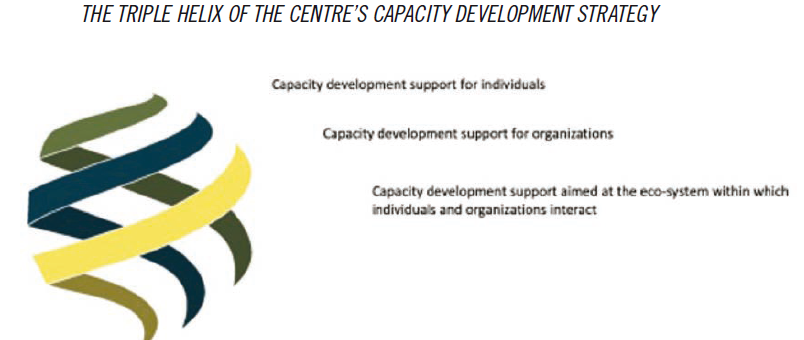
- The ITCILO capacity development approach is based on and grouped along three mutually reinforcing and interdependent levels of capacity development: individual, organizational and resulting from the enabling environment.
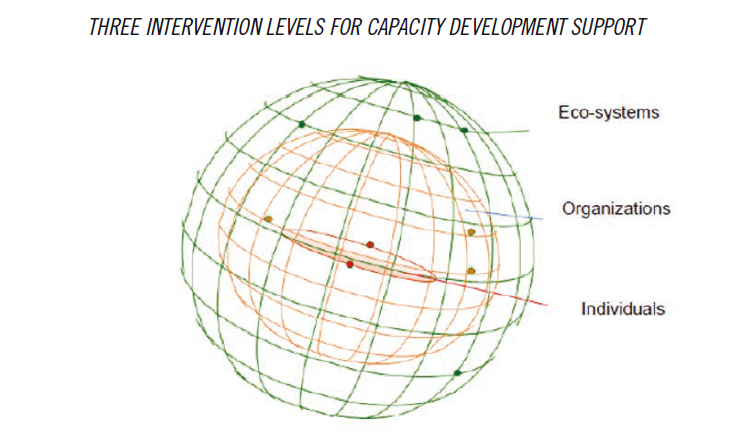
- At the Centre, technical and functional skills training dominates in terms of number of activities but that non-training activities make an important contribution to outreach and financial performance. This implies that quality management for learning services and for non-training capacity development services are equally important.
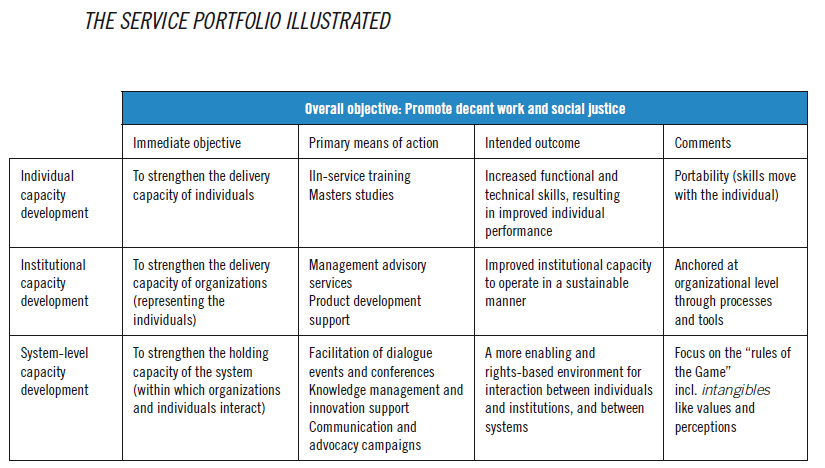
- The theory of change underpinning the Centre’s service mix takes inspiration from systems thinking. the Centre’s capacity development services are to be pictured as separate but intertwined and mutually reinforcing interventions that play out across system levels in often non-linear processes. Consequently, capacity development services should be combined for best impact and capacity accumulates over time as part of a multi-step
development process.
- In order to track change along the timeline of all its capacity development interventions, the Centre uses the following model for monitoring and evaluation purposes: Inputs -> Outputs -> Out-takes (interim outcomes) -> Outcomes -> Impact , whereby, Inputs describe the activities performed and resources used to generate results, outputs refer to the immediate results or deliverables, out-takes or intermediate/interim outcomes capture an emerging change, outcomes express lasting change directly attributable to the outputs and flowing from the out-takes, and impact relates to the long-term lasting change.
The theory of change underpinning the services of the Centre should be pictured as a chain of chains rather than a single result chain where results of one intervention feed as inputs or contributing results into concurrent or follow-up interventions.
Description of the Quality Management System
- The document is guided by the principles underpinning the work of the Centre, namely: human-centred; emphasizing employment-rich growth; embracing diversity; connected; quality-focused; participant-centred; IT-enhanced; innovative; safety first; and sustainability.
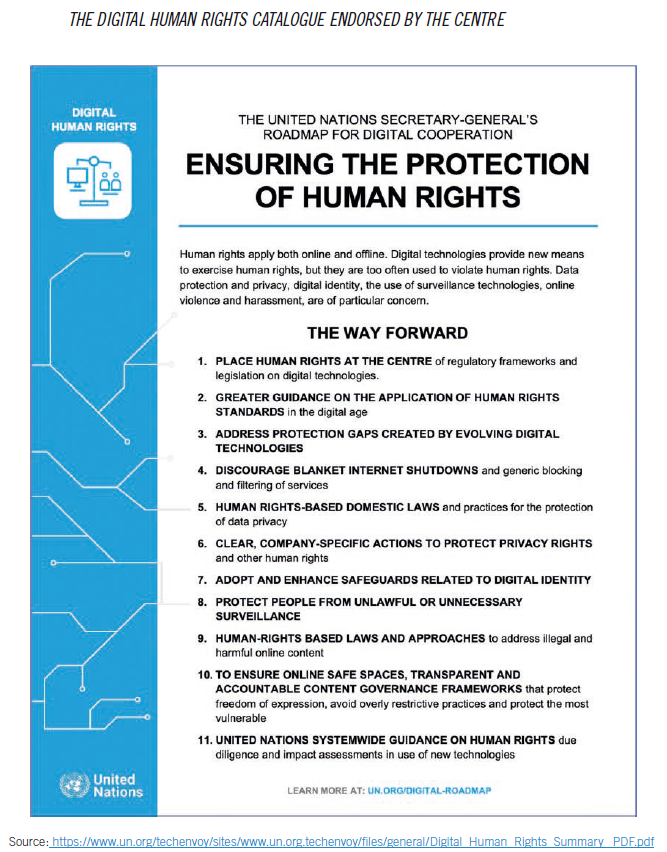
- Since quality management involves the collection, processing, analysis and dissemination of large amounts of data, the Centre puts great emphasis on digital rights, data security and data privacy.
- To manage the quality of its capacity development services, the Centre takes inspiration from the ISO recommended Plan-Do-Check- Act (PDCA) cycle, whereby
• Plan: at the outset of each cycle, the service provider, in consultation with the client, establishes the specific objectives of the activity, the guidelines governing its implementation and the resources needed to deliver the results, in accordance with beneficiaries’ requirements and the assignment’s terms of reference, and identifies and addresses risks and opportunities.
• Do: the activity is implemented in accordance with the relevant standard, and the implementation process is monitored.
• Check: the results are evaluated against policies, objectives and requirements, and activities planned, and are reported.
• Act: actions are undertaken as necessary to improve performance in subsequent cycles; these improvements may entail refinement of the terms of reference, needs assessments, definition of the resource envelope for implementation, and other measures.
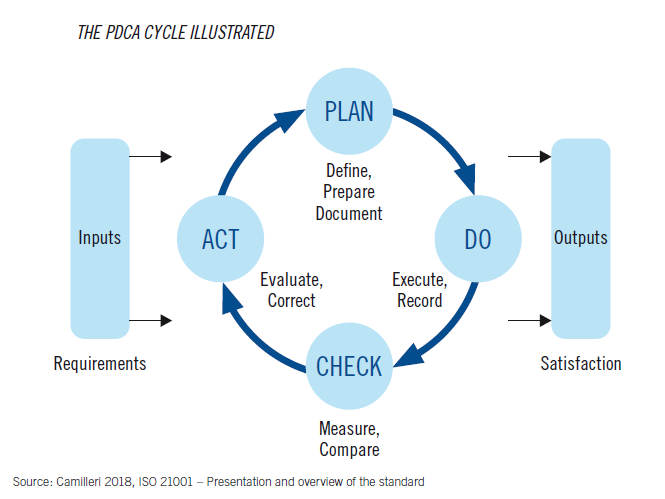
- Using the PDCA cycle as a strategy canvas, the learning services of the Centre can be mapped against the ISO 29993:2017 standard for learning services outside formal education while non-training capacity development services take inspiration from the ISO 21502:2020 standard for project, programme and portfolio management.
- As of April 2023 when this document was released, the Centre had mapped its quality assurance practices for learning services, consultancy assignments, communication and advocacy campaigns and event facilitation services along the steps of the PDCA cycle. The quality management processes and tools are meant to furnish the data required to monitor progress towards attainment of results and to validate (emerging) positive change.
- The KPIs tracked by the Centre are represented along a results chain for each service category. The KPIs are specific to each service category the data collected at each control point can be compared across the capacity development strands. These strands can thus be interwoven into a theory of change that crosscuts the three system levels of the ILO capacity development approach.
Role and Responsibilities
The Centre has a shared system of roles and responsibilities in performing quality management
functions.
- The Office of the Director provides overall direction, leadership and management of the Centre.
- The Office of the Director of Training is in charge of facilitating the quality management processes related to all capacity development services of the Centre.
- Programme management undertakes quality management functions in accordance with the present policy framework, inform donors and implementing partners, budget resources, and incorporate evaluation into annual work planning, follow up on findings, conclusions, recommendations of external evaluations, and share best practices and lessons learned.