

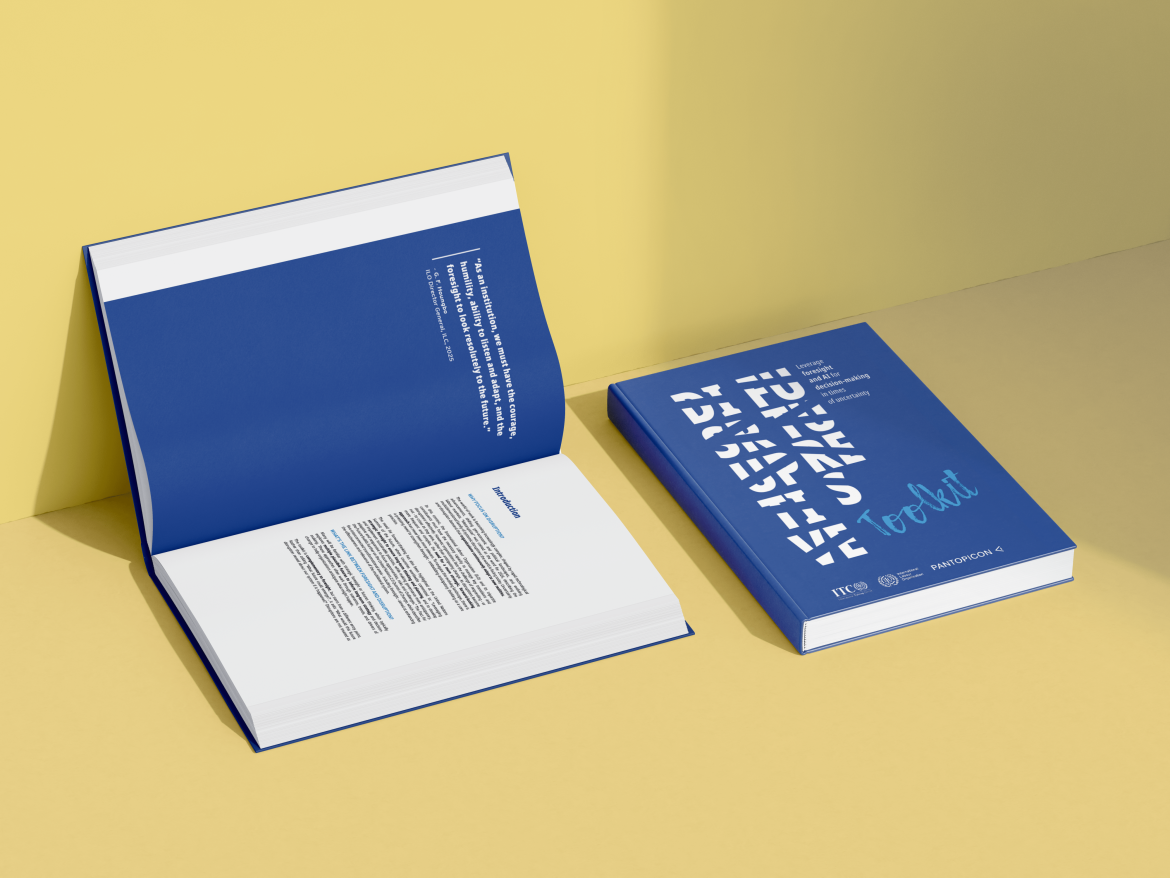
Disruptive Futures Toolkit
Disruptive Futures Toolkit
Leverage foresight and AI for decision-making in times of uncertainty

As an institution, we must have the courage, humility, ability to listen and adapt, and the foresight to look resolutely to the future.” - G. F. Houngbo, ILO Director General, ILC, 2025
Why focus on disruption?
The world of work is becoming increasingly complex, shaped by rapid technological advancements, shifting geo-economic and political landscapes, and evolving labour markets. “Metaruption” was coined as the word for 2026, describing the multidimensional family of systemic disruptions the world is facing today. Uncertainty and disruption demand that organizations continuously adapt to new realities.
In this context, the International Labour Organization (ILO) and its tripartite constituents must have the necessary capacity to manage key transitions and disruptions effectively. However, organizations face the challenge of responding - or not - to crises as they arise, rather than anticipating change. As disruptions become more frequent and complex, the need for a more strategic, forward-looking approach has never been more relevant. To navigate this evolving landscape, there is a pressing need to strengthen foresight - embedding anticipatory thinking as a core practice.
How does this toolkit address disruption?
Disruptive change is understood as change that radically alters the world as we know it, occurs over a relatively short time frame, and occurs in an interconnected manner. The toolkit is designed to create a safe and structured way to work with disruptions as thought experiments.
Specifically, this toolkit is built to:
- Adapt strategic foresight to the particular context of the world of work and support the ILO tripartite constituency with its diverse realities
- Assess major transitions through the lens of disruptive change
- Analyze how AI can be leveraged for strategic foresight
The toolkit helps to step outside habitual thinking and examine organizations or systems from a systemic perspective. Disruptions are not used as predictions of what will happen, but as provocations that surface underlying constraints and challenge existing mental models. In doing so, the toolkit supports a shift from reactive adaptation toward building resilience, and, where possible, anti-fragility, not just for today’s challenges, but for the uncertainties of the future.
What’s inside?
The toolkit provides a structured methodology with templates for individuals and institutions to analyze and act upon disruptions as opportunities for positive change.
The process, grounded in foresight and supported by AI, includes:
- The disruption and us
How do we, as a team, imagine and scope the disruption in more concrete terms? Who are we, and how do we scope our context? This step creates a shared starting point for the work that follows. Its purpose is to ensure that participants are reasoning from a comparable understanding of the disruption and a clearly scoped “we”.
- Sensitivity scan
How is the world in general - and the world of work in particular - impacted by this disruption? This scan helps participants develop a high-level picture of how a disruption surfaces and impacts across society, and what this means for the world of work. The aim is to identify areas of sensitivity: activities, processes, or arrangements that are likely to be affected early, strongly, or repeatedly.
- Chain of disruption
How does the disruption arise and cascade? Which systemic constraints in our organization does it expose? This chain helps participants understand how a disruption unfolds over time, how its impacts cascade across different levels of the system, and why it becomes disruptive for their organization or context.
- Cross-disruption analysis
Systemic constraints are structural or behavioural patterns that hold us back when disruptions unfold. Looking at the chain of disruption, what systemic constraints in your organization became visible? This analysis brings together insights from multiple Chains of Disruption to identify systemic constraints that recur across different disruptive situations.
- Red-teaming the future
You have identified the top 10 systemic constraints across disruptions that limit your organization’s ability to respond, adapt, or learn under stress. Which future disruption would trigger all stress points? This is a stress test. It deliberately asks participants to imagine a future disruption that would hit the system at its weakest points, based on the systemic constraints identified across multiple disruptions.
- From constraints to resilience through metaphor
Which resilience areas do our systemic constraints point to - and what new possibilities appear when we look at them through metaphor? This step marks a turning point in the process. After diagnosing systemic constraints and stress-testing them through red teaming, this tool shifts the focus from what limits the system to what could strengthen it.
- Kick-starting resilience
How might we take concrete, strategic action starting today that will strengthen our resilience towards potential future disruptions? This final step translates insight into action. Building on the How might we… questions developed in the previous step, this tool helps participants make resilience concrete, actionable, and situated in their own context.
Ready to tackle disruption?
This toolkit provides a collaborative, practice-oriented approach for systems to become anti-fragile. The concept of anti-fragility extends this idea by pointing to systems that do not merely withstand disruption but learn and improve because of it, becoming stronger through exposure to volatility, stress, and uncertainty. If you and your team are ready to test out the toolkit, check out the tailor-made course designed to support your organization to cope, absorb, adapt, and thrive in a time of disruption.
Interested in the toolkit?
In collaboration with