
Foresight
Photo © Unsplash/FlyD
Overview
Innovation begins where certainty ends. Rather than predicting what comes next, strategic foresight focuses on strengthening the capacity to navigate whatever does. For over a decade, the ITCILO has been helping constituents use futures, foresight and horizon scanning to inform the decisions they make today. Through three interconnected initiatives, the ITCILO is building the mindset, tools, and collaborative spaces needed to shape anti-fragile and adaptive systems.
What we offer
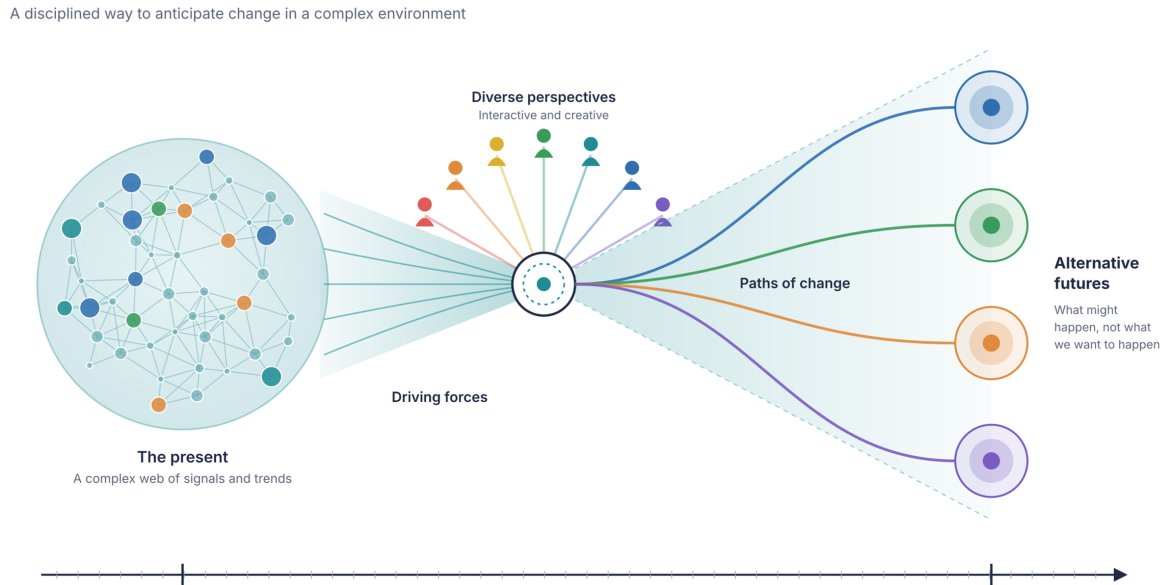
We work with organizations to embed anticipatory thinking into how they plan, learn, and decide. Our practice rests on well-established futures methods, from horizon scanning and the Three Horizons framework to futures wheels and scenario building, brought together in a toolkit organized around six activities critical to futures thinking. Every process is anchored in a collaborative signals database where participants spot, share, and pin early signs of change, and extended through three alternative approaches that ask different questions of the future:
- Intergenerational Foresight: who else sees the future? Our intergenerational foresight workshops bring children as young as eight to the same table as adults over sixty-five to imagine the future of learning and work. Through play and non-hierarchical dialogue, participants break out of generational echo chambers and reach perspectives neither group could find alone.
- Disruptive Futures: what would break us? Most institutions are built to react, not to anticipate. The Disruptive Futures Toolkit proposes a hands-on, AI-powered methodology that helps people stress-test their systems, uncover hidden weaknesses, and design smarter responses to disruptions. The first step to resilience is strengthening the muscle to adapt, and trade union leaders can build it through a dedicated masterclass on strategic foresight for trade union development.
- Reconnecting Futures: whose knowledge counts? Living knowledge traditions are not only heritage to preserve; they are working infrastructure for building futures. Reconnecting Futures invites partners to co-design a framework grounded in relationality, epistemic justice, and custodianship, offering an alternative to extractive AI adoption in education systems across the Global South.
What we do
We design and facilitate participatory foresight processes, from single workshops to multi-week blended programmes and global participatory spaces, that turn uncertainty into shared direction. Each one follows the same arc: scan for signals, imagine alternatives, and act on what matters. Practitioners can also learn the approach themselves through our tailor-made course on futures, foresight, and horizon scanning.
Recent collaborations:
- IE University and Granstudio: Through Learning in Motion, mobile learning was reimagined by taking the emphasis off of digital devices and placing it on the learners themselves. In a not-so-distant future, physical settings and virtual realities blur; learning and training opportunities are not confined to four walls or bound by a structured curriculum. Developed with the European Training Foundation, the resulting publication maps 8 driving forces, 24 signals, and 4 scenarios for learning in 2050.
- ILO Occupational Safety and Health: The future of safety and health was imagined collectively in ILO’s Occupational Safety and Health (OSH) foresight exercise led online and in virtual reality. Through a global participatory space, participants explored emerging risks, trends, and uncertainties shaping workplaces. Structured methodologies and collaborative scenario-building shaped the OSH Outlook Report 2026.
- African Development Bank: Strategic foresight was brought into development finance through a blended programme: four weeks of online microlearning, case studies, and live webinars delivered in English and French. Participants applied horizon scanning, scenario planning, future personas, and backcasting to challenges drawn from the Bank's own context, leaving with actionable strategies for their teams.
- Helvetas: The future of green and inclusive economic opportunity for women and youth was explored up to 2035 with RECONOMY, a regional programme on inclusive economic development across eleven countries in the Eastern and Western Balkans. Around 40 programme staff scanned for signals of change, prioritized critical uncertainties, and built four scenarios to stress-test their own interventions. Strategy was then planned backwards from the desired future, making foresight a regular part of how the programme plans rather than a one-off exercise.
Ready for the future?