
Reclaiming Curiosity and Serendipity at Work
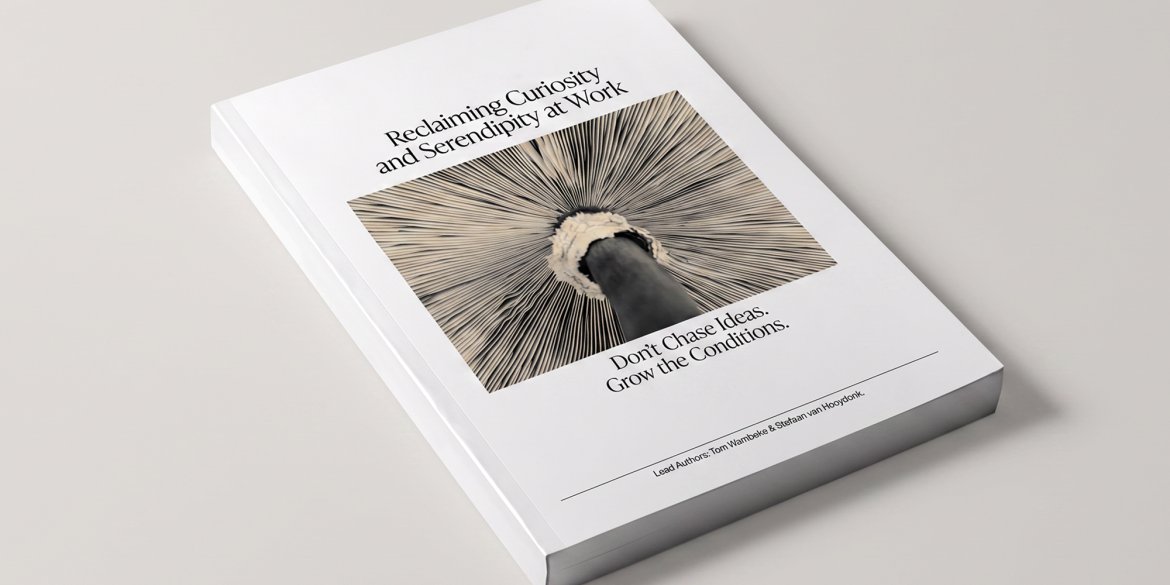
What if the biggest obstacle to innovation isn't a lack of brilliant ideas, but the environment in which we expect them to emerge?
Reclaiming Curiosity and Serendipity at Work explores a different way of thinking about creativity, learning and organisational change. It argues that curiosity is not simply a personality trait, nor is serendipity just good luck. Rather, both are outcomes of the conditions we create; conditions that encourage people to question, explore, connect seemingly unrelated ideas, and remain open to the unexpected.
Drawing on insights from complexity science, organisational learning and the remarkable interconnectedness of mycelial networks, the publication offers a compelling framework for designing workplaces where discovery becomes more likely. It also introduces practical strategies that leaders and teams can use to cultivate curiosity, embrace uncertainty and unlock new possibilities through questioning, reflection, reframing and exploration.
Whether you're leading a team, shaping learning experiences or navigating an increasingly complex world, this publication invites you to stop chasing ideas and start growing the conditions in which they naturally flourish.
Curiosity is not about the quantity of our questions, but about the quality of our attention.
An ecology that makes curiosity and serendipity possible
The publication draws inspiration from mycelium: the vast networks of fungal threads that connect, nourish and sustain forest ecosystems. Above ground, a forest may appear to be made up of separate trees. Beneath the surface, however, it is an interconnected system that exchanges nutrients, carries signals and responds collectively to change.
This offers a useful model for creative and organisational discovery:
- Curiosity is the motion: the thread that probes, branches and enters unfamiliar territory.
- Serendipity is the outcome: the unexpected connection or useful surprise that emerges.
- Entanglement is the condition: the relationships, diversity and permission that make discovery possible.
The more genuine inquiry an organisation introduces into a rich and connected system, the more that system can respond in ways that could not have been predicted or planned.
Serendipity is not a miracle. It is, more often than not, a network effect of curiosity operating in an entangled environment.

Rather than offering a formula for innovation, this publication invites you to rethink how it happens in the first place. Whether you're looking to strengthen your team, reimagine learning or spark new ways of thinking, this publication offers inspiration for the journey ahead.