
Global Conversation on Access to Labour Justice

Image © Alice Lotti
Global Conversation on Access to Labour Justice
A blended global learning platform
16 Novembro–4 Dezembro 2026
O curso está disponível em English
Can institutions truly deliver justice at work, and how would you know?
Access to labour justice is central to fair, stable labour markets — yet growing caseloads, institutional gaps and rapid digitalisation are testing systems worldwide. This Global Conversation brings together judges, mediators, ministries and social partners to compare what works across countries and institutions. Participants leave with concrete strategies to strengthen labour justice systems in their own context.
Key features
Global Perspective
Explore real-world solutions through international case studies and comparative practices from diverse legal and institutional contexts
Peer-to-peer learning
Learn directly from practitioners across regions and sectors, sharing good practices in an international environment
Certificate of Achievement
Successful participants will be awarded an ITCILO Certificate of Achievement
Apresentação do curso
Fair and effective labour justice systems are the cornerstone of stable, inclusive and resilient labour markets. They are essential to preventing and resolving disputes, protecting rights at work, and building trust between workers, employers and institutions. Yet as the world of work rapidly evolves, so do the challenges and opportunities related to labour justice. Barriers to access, complex and often lengthy procedures, limited institutional capacity, and gaps in legal protection continue to test the effectiveness of existing systems. Digitalisation is transforming how disputes are filed, processed, and resolved. At the same time, progress is evident: innovative initiatives are closing labour justice gaps around the world. This Global Conversation Series on Access to Labour Justice provides a dynamic blended platform to explore practical solutions, innovative ideas and emerging opportunities. Grounded in ILO international labour standards on labour dispute prevention and resolution and enriched by comparative practice and a robust academic foundation, the course combines cutting-edge knowledge with hands-on, interactive learning. Participants exchange experiences, challenge assumptions and develop concrete, actionable strategies to make labour justice systems more accessible, inclusive and effective.
Perfil dos participantes
This course brings together a diverse network of professionals working in or around labour justice and dispute resolution, including: Labour dispute resolution practitioners - judges, magistrates, mediators, conciliators, arbitrators Public administration staff - Ministry of Labour, Ministry of Justice Employers' and workers' representatives Industrial relations practitioners ILO experts and project staff Academics and researchers working on labour law and access to justice

What will I learn?
1. Foundations of labour justice systems
Principles, functions and global perspectives on labour justice — including the distinction between judicial and non-judicial mechanisms and the role of international labour standards. Grounded in ILO guidance on labour dispute prevention and resolution.
2. Legal and regulatory frameworks
Ensuring scope, coverage and effective access to labour justice — examining how legal frameworks shape access for workers, including migrant workers and those in the informal economy.
3. Institutions and mechanisms in practice
Courts, tribunals and alternative dispute resolution (ADR) processes — their design, functions, strengths and limitations in different national contexts.
4. Institutional performance and effectiveness
Making labour justice systems more operational using the ILO's principles of effectiveness for labour dispute prevention and resolution — including caseload management, timeliness, and enforcement of outcomes.
5. The role of social partners
The contribution of employers' organisations and trade unions to labour dispute prevention and resolution — including collective bargaining, grievance mechanisms, and bipartite dispute prevention initiatives.
6. Digitalisation and labour justice
How digital tools and e-justice reforms are reshaping how disputes are filed, processed, and resolved — including digital case management systems and their implications for access to justice.
7. Comparative experiences and peer learning
Sharing practices and insights across legal traditions, institutions and regions — including focus on specific sectors and geographic contexts.
What will I be able to do?
By the end of this blended course on access to labour justice, you will be able to:
- Understand the key features of effective, accessible and inclusive labour justice systems
- Analyse the legal, institutional and procedural dimensions of labour dispute prevention and resolution
- Identify critical challenges related to accessibility, effectiveness and enforcement
- Compare judicial and non-judicial mechanisms, including alternative dispute resolution (ADR)
- Draw on international experiences and translate them into your own national or institutional context
- Engage with peers to exchange insights and share good practices in labour justice reform
- Develop practical, action-oriented solutions to improve access to labour justice
How does the course work?
This highly interactive blended course runs across three phases:
- Phase 1 — Online (16–20 November 2026) : Introductory online module via the ITCILO eCampus portal. Participants engage with preparatory materials, interactive modules, and facilitated online discussions to build a shared foundation before the residential week.
- Phase 2 — Residential in Turin (23–27 November 2026) : Five days at the ITCILO Campus in Turin. Immersive, face-to-face sessions including expert presentations, real-life case studies, group work, peer exchange, and participatory workshops. Participants are accommodated at the campus with full board and private facilities.
- Phase 3 — Online (30 November – 4 December 2026) : Consolidation online module. Participants apply learning to their own contexts, complete assignments, and engage in a final exchange of good practices and action plans.
Why join this course?
- Cutting-edge knowledge — The course draws on the latest ILO research, including the outcomes of the 2025 Tripartite Technical Meeting on Access to Labour Justice for All and emerging comparative practices.
- Blended depth — Combine the flexibility of online learning with the intensity of a residential week in Turin for richer exchange and networking.
- A truly global community — Meet and learn from judges, mediators, ministry staff and social partners from across the world.
- Actionable takeaways — Leave with concrete strategies and tools applicable to your specific institutional and national context.
- ILO-grounded content — All teaching is anchored in ILO international labour standards and comparative legal practice.

Accommodation and travel
The course fee includes full board accommodation at the ITCILO campus in Turin, routine medical care, medical insurance, and internet access.
Travel costs are not included in the course fee and remain the participant's responsibility.
Practical information
- Language — The entire training programme is conducted in English. A good command of the language is required.
- How to apply — Click Apply Now and complete the online form. Applications are reviewed through a selection process, subject to receipt of the completed application form and a sponsorship letter from the employing organization covering the course fees.
- Payment and cancellation — The total fee must be paid in advance. To withdraw, notify the Centre in writing at least 14 days before the course start date. See the full payment and cancellation policy.
Your questions, answered
What does the course fee include, and what is not covered?
The fee includes full-board accommodation at the ITCILO campus in Turin, routine medical care, medical insurance and internet access. It does not cover travel costs to and from Turin, passport and visa fees, or airport taxes.
Who is this course designed for?
This course is designed for professionals working in or around labour justice systems — including judges, mediators, conciliators, arbitrators, ministry staff, social partners, ILO project staff, and researchers. No specific prerequisites are required beyond a professional interest in labour dispute prevention and resolution.
Is the residential phase mandatory?
Yes. All three phases of the blended programme are part of the course. Attendance at the residential week in Turin (23–27 November 2026) is expected and included in the course fee.
Does the course lead to a certificate?
Successful participants receive an ITCILO Certificate of Achievement. Learn more about ITCILO digital credentials.
What happens if I need to withdraw after registering?
Participants must notify the Centre at least 14 days before the course start date. Cancellation penalties may apply — see the full Payment and Cancellation Policy for details.
Ready to strengthen your understanding of labour justice systems?
16 November – 4 December 2026 · Blended · English
Start learning about this topic
For further reading on labour dispute prevention and resolution, explore the full ILO Labour Dispute Prevention and Resolution publications.
Access to labour justice: A diagnostic tool for self-assessing the effectiveness of labour dispute p
A practical evaluation methodology for assessing national labour justice systems (ILO, 2023)
Comparative law and practice on labour disputes prevention and resolution
Access to labour justice: A comprehensive comparative review of national systems (ILO, 2023)
Adopted conclusions of the Tripartite Technical Meeting on Access to Labour Justice for All
The tripartite framework emerging from the February 2025 ILO meeting in Geneva

Justice across borders: Access to labour justice for migrant workers
Cross-border dimensions of labour justice (ILO, 2024)
Developing effective digital case management systems for labour dispute prevention and resolution in
ILO Working Paper 142 (2025)
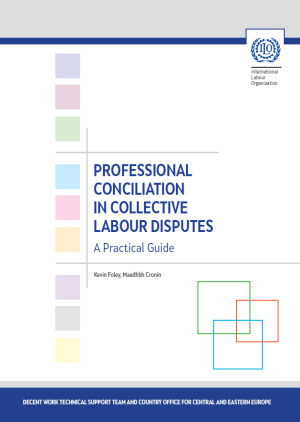
Professional conciliation in collective labour disputes: a practical guide
A practitioner-oriented guide to conciliation methodology


