EMOTIONAL INTELLIGENCE AT WORK (TAILOR-MADE)

Photo © Adobe Stock/master1305
EMOTIONAL INTELLIGENCE AT WORK (TAILOR-MADE)
MASTERING EI AND HUMAN DYNAMICS TO STRENGTHEN COMMUNICATION AND PERFORMANCE
THIS TAILOR-MADE COURSE IS AVAILABLE UPON REQUEST AND IS CO-DESIGNED WITH EACH ORGANIZATION. CONTACT US TO LEARN MORE
The course is available in English
Most organizations struggle when people stop working well together. Tensions build up unseen, meetings produce little alignment, and unwritten rules decide who speaks and who stays silent. What is missing is rarely goodwill. It is a shared set of practical skills.
This tailor-made course is co-designed with you and works on the human foundations of work, how people communicate, how they manage emotions, and the unwritten codes that shape who is heard, who leads and who is safe. Over three days, your team works on real situations from your own workplace and leaves with practices it can apply straight away.
Key features
TAILORED TO YOU
Each course is co-designed with your leadership, HR and operations teams, so it speaks directly to your goals and challenges.
LEARNING BY DOING
Live exercises, simulations and theatre-based rehearsal, built on situations drawn from your own workplace.
ORGANIZATIONAL LEARNING
Build a system that works: stronger relationships, sharper communication, and a workplace where performance thrives. Learn it together with your colleagues.
FLEXIBILITY
Join us at the ITCILO Innovation Lab in Turin, Italy, or let us come to you, at your headquarters, a regional office or any other location that works for you. Select all the modules or only the one(s) you need.
Tailor-made training for teams
Every organization invests in systems, processes, and strategy. Far fewer invest systematically in the emotional intelligence of their people, the foundation that allows those investments to deliver results. Without it, even the best-designed systems run on a hidden code that no one chose: the unwritten rules about who speaks, who stays silent, and how people respond when something goes wrong.
When emotional intelligence is weak, that code produces predictable outcomes. Teams stop communicating across silos, conflict surfaces too late, and harassment goes unreported. More than one in five people in employment worldwide have experienced violence or harassment at work, and only about half of them told anyone (ILO, Lloyd’s Register Foundation and Gallup, 2022).
At ITCILO, we provide practical, hands-on training that equips UN organizations, international organizations, public institutions and multinational companies with a common language and shared practices to work well together under pressure, across functions and in hybrid settings.
We focus on action over theory. Participants do not just learn about communication, emotions or workplace culture. They practice them, rehearse them, and leave with a concrete change to make at work.
Co-creating the course
Each course starts with a preparation conversation with your leadership, HR and operations teams. It covers the group’s composition, the hierarchy within it, its working languages and its cultural setting. Using these inputs, our facilitators adjust examples and scenarios so that the situations discussed in the room are ones participants will recognize from their own work.
The course is scalable, from a single team to a department or the whole organization. It works best when groups mix managers and staff, HR and operations, and different functions and levels, which builds shared understanding and breaks silos.
Who attends this course?
Senior Managers and Executive Teams
Chief Operating Officers and Operations Managers
HR Directors and People Managers
All Staff
What will I learn?
The course is built around three capabilities that organizations cannot afford to leave to chance. Each one is delivered as a full day, and each day builds on the one before.
Emotional intelligence as a professional competence
What you’ll learn
Emotions are already present in the workplace, trained or not. This module makes them manageable, constructive and professionally grounded, with particular attention to leadership roles and high-stakes environments.
How you’ll learn
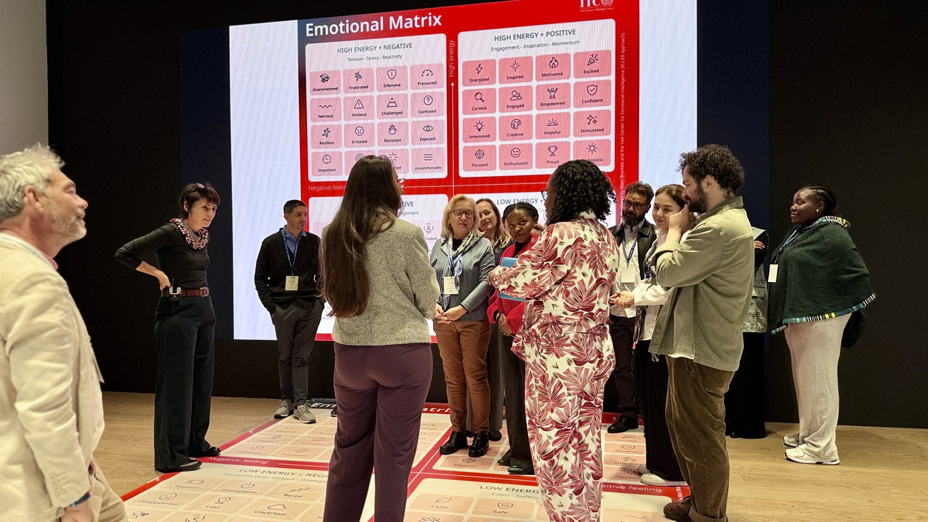
- Name emotions with a shared vocabulary, using a life-size emotional matrix inspired by the RULER approach of the Yale Center for Emotional Intelligence.
- Build self-awareness and emotional regulation under pressure.
- Practice empathy without losing authority, with sensitivity to social differences.
- Use practical tools to de-escalate conflict and restore trust.
The result is healthier workplace climates, stronger trust and more balanced decision-making.
Communication that delivers clarity and accountability
What you’ll learn
This module focuses on real, everyday communication. Participants learn to communicate clearly without escalating tension, to listen beyond words, roles and assumptions, and to address difficult conversations early, before they become costly.
How you’ll learn
- Practice giving and receiving feedback without defensiveness.
- Rehearse difficult conversations drawn from your own workplace.
- Strengthen how you communicate under stress, pressure or disagreement.
In practice, this reduces misunderstandings, unnecessary escalation and unproductive meetings, and increases clarity, ownership and efficiency.
Reworking the codes of power
What you’ll learn
Every workplace runs on unwritten rules about who speaks, who leads and who is safe. This module works on the conditions that hold those rules in place, rather than on attitudes alone. Participants move through the CODE framework, Catch, Observe, Dare and Enact, from naming the codes they have seen at work to changing one condition that keeps a code in place. The module applies the preventive logic of ILO Convention No. 190 and Recommendation No. 206 at the level of teams.
How you’ll learn
- Name the codes rewarded, expected or punished in your workplace, codes of power and masculinity among them.
- Read a workplace scene by its structures and norms first, and by the person last.
- Rehearse change through Image and Forum Theatre, on composite scenes so that no one’s own experience is on stage.
- Leave with one defined change to a condition within your own authority, scheduled before the session ends.
Image and Forum Theatre come from the Theatre of the Oppressed, the method Brazilian director Augusto Boal developed in the 1970s, drawing on Paulo Freire’s pedagogy. Boal’s intention was to turn spectators into active participants, people who do not simply watch a situation of injustice but step into it and try to change it. For him, theatre was a place to rehearse action before taking it in real life. That makes it particularly suited to work on gender and power, for two reasons. The codes that decide who speaks, who leads and who is safe are hard to name directly, and a scene lets people show what they would struggle to say, at a distance that invites reflection rather than blame. It also treats change as something to practice, not only to understand, so participants leave having already tried, in a protected setting, what they intend to do at work.
What is the course methodology?
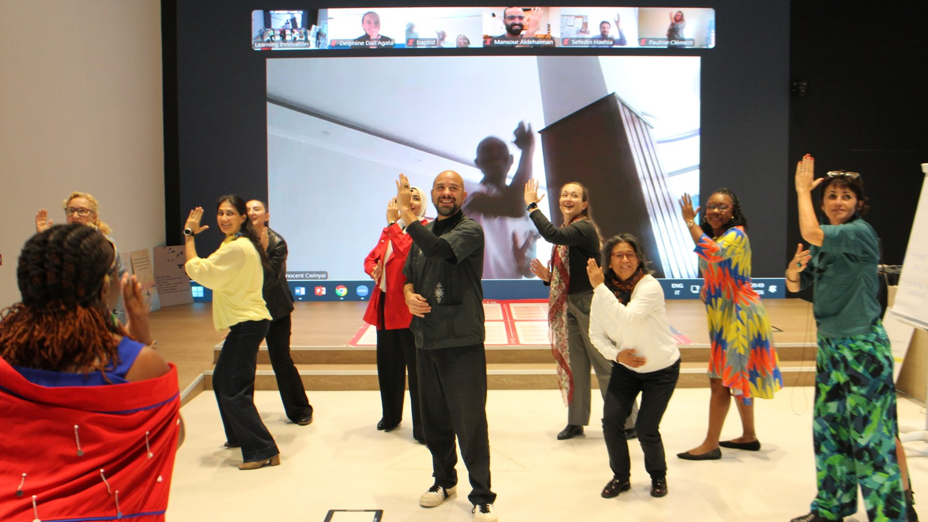
The methodology is practical and experiential, tailored to the needs and working practices of your organization. Participants work on real situations and actual tensions, not hypothetical cases, through live exercises, simulations, theatre-based rehearsal and guided reflection.
The course can run at the ITCILO Innovation Lab in Turin or at your premises. The first two days can also be delivered as live online sessions. The third day relies on rehearsal in the room, so it runs in person or hybrid. Individual or small group coaching and a self-paced learning pathway can be added.
Course structure
Below is a sample structure for the three-day format. However, the modules can also be selected independently or combined in any way that suits your organization’s needs.
Preparation (before the course)
A preparation conversation with your organization sets the format, the group composition and the examples used in the room.
Day 1, Emotional intelligence (full day, in person, hybrid or online)
Participants build self-awareness, emotional regulation and empathy, and learn tools to de-escalate conflict and restore trust.
Day 2, Communication (full day, in person, hybrid or online)
Participants strengthen everyday communication, from feedback to difficult conversations, and practice communicating under pressure.
Depending on your needs, the course can also integrate crisis and high-pressure communication, digital and social communication awareness, and AI-supported communication.
Day 3, Power and workplace codes (full day, in person or hybrid)
Participants map the conditions behind the unwritten codes of their workplace, rehearse change through Image and Forum Theatre, and leave with one change scheduled in their calendar.
Follow-up (after 30 days)
A short check-in, about two minutes from a phone, asks whether each change happened, what shows it, and what followed in the team.
What impact can I expect?
After this course, organizations typically report:
- smoother collaboration across teams
- fewer unresolved conflicts and escalation cycles
- clearer communication and faster alignment
- stronger trust, engagement and retention
- improved leadership behaviors at all levels
The third day also gives you something you can check, reports at 30 days of which conditions participants have changed.
Who are the trainers?
The course is delivered by experienced international and certified facilitators from the ITCILO Learning Innovation Programme, together with specialists in communication and Theatre of the Oppressed.