Creating Jobs Through Development Projects

Photo © AdobeStock/Chloe
Creating Jobs Through Development Projects
How to deliver and measure decent work results
23 Noviembre–11 Diciembre 2026
El curso está disponible en English
Key features
Project-cycle approach
Integrate employment and decent work from project identification and diagnosis through strategy design, implementation, monitoring and evaluation
Work on a real project
Participants apply course tools to their own live or pipeline development project across the online and face-to-face phases
A systemic view of job creation
Analyse how labour demand, labour supply, institutions, market intermediation and other actors interact to shape employment outcomes, and identify where development projects can make a difference
Presentación del curso
Development projects frequently promise jobs, but translating that ambition into real, sustained and decent employment outcomes is complex. Jobs rarely result from a single intervention: they emerge from the interaction of firms, workers, public institutions, education and training providers, social partners, policies and wider economic conditions. Project teams therefore need to diagnose the structural constraints that limit employment creation, identify the actors and enabling conditions they can realistically influence, and design coherent strategies that address labour demand, labour supply, institutions and labour-market intermediation. This blended ITCILO course equips development professionals with practical concepts and tools to integrate employment and decent work throughout the project cycle. Participants learn to conduct an employment-focused problem analysis, develop context-specific employment strategies, translate them into implementation choices and theories of change, and monitor and evaluate employment and job-quality results credibly. The learning experience combines online preparation, an intensive five-day workshop at the ITCILO Campus in Turin, and a post-workshop application note. Throughout the course, participants apply the methods to their own live or pipeline projects, turning the learning into concrete improvements in project design, implementation and results measurement.
¿Quiénes participan en este curso?
Development professionals who design, manage, finance, implement, monitor or evaluate projects with actual or potential employment and decent work outcomes, including staff from donor agencies, international financial institutions, United Nations organizations and government institutions. Professionals from non-governmental organizations, social partners and consulting firms involved in development projects and programmes where job creation is an explicit or implicit objective. Practitioners working on employment and youth employment, enterprise and private-sector development, market systems and value chains, skills development, employment services, local economic development, transitions to formality, infrastructure and related areas. No advanced economics is required. Familiarity with project cycles and results frameworks is helpful. Participants are strongly encouraged to bring a live or pipeline project that they can use as a practical case throughout the course.
Objetivos del curso
After this course, participants will be able to:
- Mainstream employment and decent work considerations throughout the project cycle, from identification and design to implementation, monitoring and evaluation.
Define jobs and decent jobs in operational and measurable terms for development projects. - Conduct an employment-focused problem analysis using a systemic lens to identify key constraints, actors and enabling conditions affecting decent job creation.
- Design context-specific employment strategies that combine and sequence interventions across labour demand, labour supply, institutions and labour-market intermediation.
- Use evidence, research and lessons from previous interventions to assess promising approaches and adapt them to the project context.
- Plan credible monitoring and evaluation of employment and job-quality results, including jobs created and sustained, full-time equivalents, net additionality, indirect effects, contribution and attribution.
- Apply employment-focused project design and measurement tools to a live or pipeline project from their own professional context.
Contenido del curso
ITCILO eCampus platform, from 23 November to 4 December 2026

- Module 1: Introduction to the project cycle and key employment concepts - Revisits the project cycle and introduces key concepts related to employment, jobs and decent work
- Module 2: Understanding structural constraints behind employment creation and diagnosing constraints - Examines employment as a structural challenge and introduces a systemic approach to problem analysis and project identification. Participants explore labour demand, labour supply, labour-market intermediation, key actors and the constraints and enabling conditions that a project can realistically influence.
- Module 3: From diagnosis to employment strategy - Explores how to translate an employment diagnosis into a coherent project strategy, combining interventions across labour demand, labour supply, institutions and intermediation and drawing on evidence and lessons from previous interventions.
By the end of the online phase, participants identify a live or pipeline project from their own professional context to use as a practical case during the face-to-face workshop.
ITCILO Campus in Turin from 7 to 11 December 2026
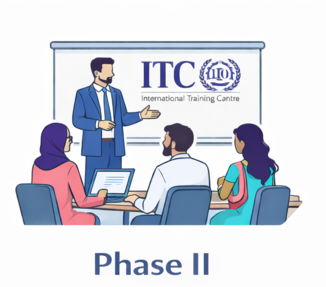
- Module 4: Deepening the diagnosis: constraints, actors and needs - Participants deepen their employment diagnosis, analyse the main constraints to creating more and better jobs, examine stakeholder needs, and identify the actors, functions and enabling conditions shaping employment outcomes.
- Module 5: Designing the employment creation strategy - Participants assess intervention options and consider how measures addressing labour demand, labour supply, institutions and labour-market intermediation can be combined and sequenced for the specific context.
- Module 6: Implementation, adaptation and sustainability - Focuses on translating the strategy into a theory of change and using it to guide implementation, with attention to assumptions, risks, stakeholder engagement, adaptive management and sustainability of employment effects.
- Module 7: Monitoring, evaluation and learning - Covers credible measurement of employment and decent work results, including jobs created and sustained, job quality, full-time equivalents, net additionality, indirect effects, contribution and attribution, while emphasizing evidence for learning and project improvement.
- Module 8: Consolidation and project presentations - Participants consolidate the work developed throughout the course and present the employment strategy for their live or pipeline project, receiving feedback from ITCILO experts and peers to refine assumptions and strategic choices.
ITCILO eCampus, online submission (January 2027)
Participants prepare a short application note setting out how they will mainstream job creation and decent work considerations into their professional practice and future projects. The note serves as a concise action plan for applying the course concepts and tools beyond the training.
Metodología
The course uses a blended, participatory and practice-oriented learning approach structured around three complementary phases.
The online phase runs from 23 November to 4 December 2026 on ITCILO eCampus platform and introduces the core concepts and tools for employment-focused project diagnosis and strategy design. Participants then attend an intensive five-day face-to-face workshop at the ITCILO Campus in Turin from 7 to 11 December 2026, where expert input is combined with facilitated discussion, peer exchange, group work, practical exercises and collaborative problem-solving. In January 2027, participants complete a short post-workshop application note to consolidate and transfer their learning to their own professional context.
A live or pipeline development project serves as the common thread across the course. Participants progressively apply the concepts and tools to this project, deepen the diagnosis, refine the employment strategy, and explore implementation, monitoring and evaluation. The programme represents a total learning effort of at least 60 hours.
¿Por qué elegir este curso?
- It addresses employment creation as a system-level project challenge rather than treating jobs as a simple output or target.
- It connects employment analysis directly to practical project-management decisions across identification, design, implementation, monitoring and evaluation.
- Participants work on their own live or pipeline projects and leave with a refined employment strategy and a concrete application plan.
- The course combines employment-policy expertise with practical tools for measuring both the quantity and quality of employment results without overstating attribution.
- The blended format combines flexible online preparation with intensive face-to-face work, expert feedback and peer learning in an international professional environment.
Certificación
Participants who successfully complete all three phases of the programme and meet the required assessment criteria will receive an ITCILO Certificate of Achievement.
Successful completion includes the required assignments, knowledge checks and other assessment activities across the online, face-to-face and post-workshop phases. The programme represents a total learning effort of at least 60 hours. The certificate is issued electronically, secured through blockchain technology, and can be shared on professional and social media platforms.
Common questions
Do I need prior experience to participate?
No advanced economics is required. Familiarity with project cycles and results frameworks is helpful. Participants are strongly encouraged to bring an example of a live or pipeline project so they can apply the course tools throughout the learning process.
How is this blended course structured?
The course has three complementary phases: an online phase f
How much time should I dedicate to the course?
The full programme represents a total learning effort of at least 60 hours across the online, face-to-face and post-workshop phases.
What technical requirements do I need for the online phase?
Participants need a computer or mobile device to access the online learning component and course materials through the ITCILO learning environment.
Where will the face-to-face component take place?
The in-person workshop will take place at the ITCILO Campus in Turin, Italy, from 7 to 11 December 2026.
Will I work on my own project during the course?
Yes. Participants identify a live or pipeline project from their professional context during the online phase and use it as a practical case throughout the face-to-face workshop. The same learning is then consolidated through a post-workshop application note.
Will I interact with trainers and other participants?
Yes. The methodology combines expert input with hands-on exercises, facilitated discussions, peer exchange, group work and practical application. The face-to-face workshop provides dedicated opportunities to test ideas, compare approaches across country and institutional contexts, and receive feedback from ITCILO experts and fellow participants.
Will I receive a certificate?
Yes. Participants who successfully complete all three phases and meet the assessment criteria will receive an electronic ITCILO Certificate of Achievement secured through blockchain technology.
What is the course fee?
The tuition fee is EUR 2,820.
Are fellowships available?
ITCILO will offer a limited number of fellowships that may cover part of the fee. If eligible, early applicants will be given priority.


