
AI Skills Training for Institutions: Inside the ITCILO AI Forum
AI Skills Training for Institutions: Inside the ITCILO AI Forum
From Turin to Nairobi to Chișinău, the ITCILO AI Forum keeps moving from ideas on paper to tools people use.
Key Takeaways
ONE KEY NUMBER
33 prototype ideas across three editions in Turin, Nairobi and Chisinau
THE BIG IDEA
Every AI Forum follows ITCILO's own model. Participants bring a concrete problem from their own work and spend three days turning it into a prototype. What changes with each edition are the questions, the methods and the tools.
QUOTABLE
"We arrived with an idea of what we wanted. But the forum helped us understand it better and go a bit further."
- Mariana Balboni, Coordinator, socialprotection.org
On the last morning of the AI Forum, a group of central bankers and HR specialists presented a prototype idea they had spent three days developing. They called it “AI Academy”, inviting staff to spend ten minutes of practice each day with a tip, a quiz, a short prompt-writing exercise or a small task to try at work.
The idea grew out of a common concern among the participating institutions. Staff were already using AI tools, often before any policy was in place, and nobody had shown them how to use those tools well.
The forum ran from 16 to 18 September 2026 in Chisinau, Moldova. Convened by the Center of Excellence in Finance (CEF), the National Bank of Moldova hosted the event with the ITCILO as designers and facilitators of the programme. Central bankers, financial sector professionals, HR specialists and technology experts came from Moldova and the wider Balkan region to explore how institutions can keep learning as AI changes the way they work. Chisinau was the third city to host the forum, after Turin in 2024 and Nairobi in 2025.
A steady foundation for changing questions
Every AI Forum is built on the same foundation. Experts, policymakers and practitioners speak on panels, and what they say goes straight into the group work at the tables. The tables are deliberately mixed. Governments, workers' and employers' organisations, international agencies, start-ups and universities work side by side, so every idea is tested against more than one point of view.
Over three days, participants move from a problem to a solution and then to a prototype. On the first day, they name a real challenge from their own work. On the second, they shape a response and test it. On the third, they build something they can show to the room.
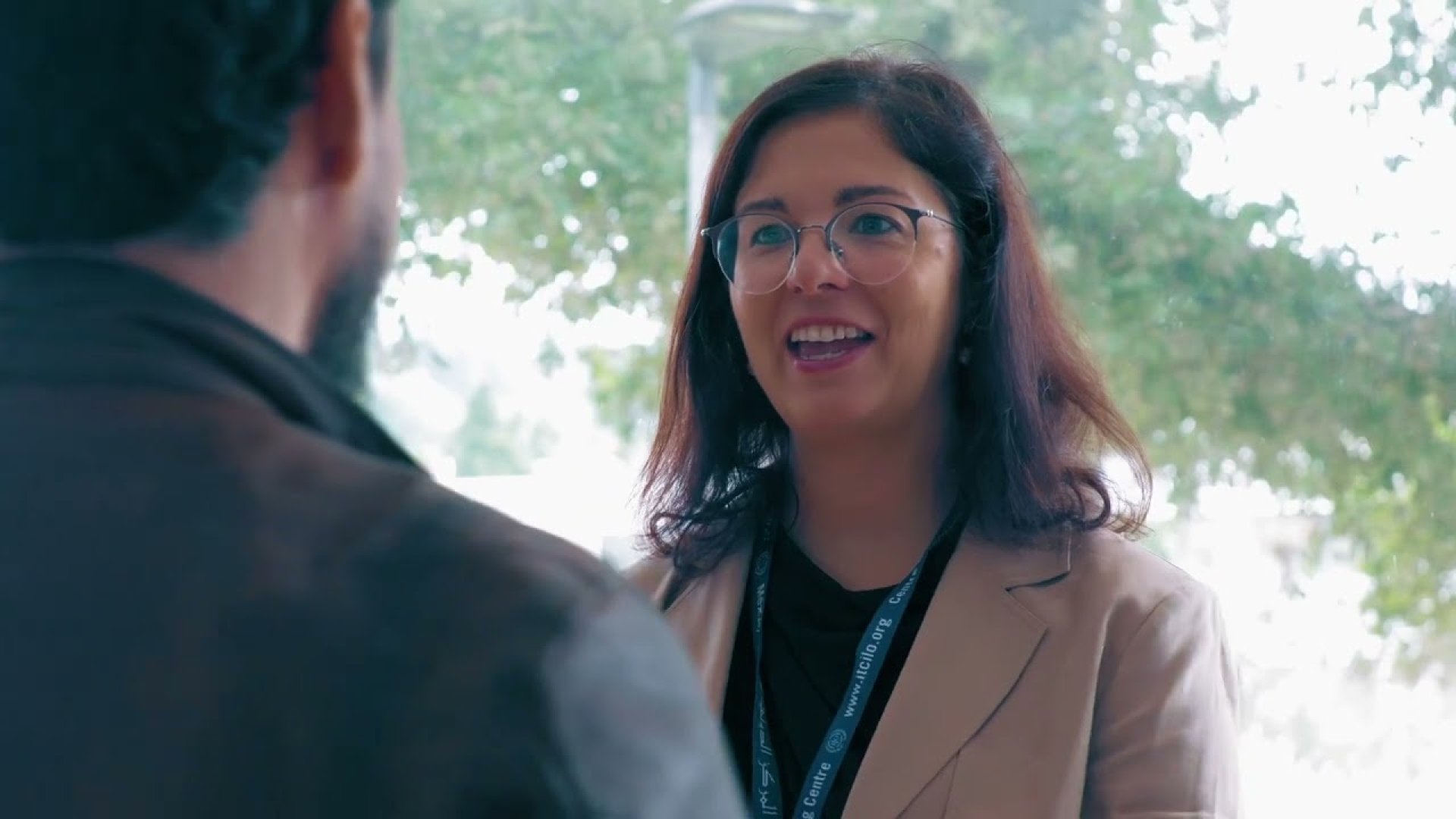
What changes is the question at the centre. Each edition takes up the one question participants most need answered at the time.
In Turin in September 2024, the Centre welcomed 90 participants from 22 organisations and also opened the sessions to an online audience. It was an unusual mix. INTERPOL officers sat beside Italian school leaders, trade unionists from Ghana and Indonesia, employers from the Philippines and Panama, and staff from UNICEF and WHO. They came with very different jobs but similar questions: What can AI do for my work? What should we be careful about? Where do we start?
A year later at the AI Forum in Nairobi, the questions grew to the size of a country. Kenya had recently launched its National AI Strategy. More than 100 people from government, workers' and employers' organisations, start-ups and civil society came together to ask how AI could create decent work without leaving anyone behind.
Paul Erukudi, who represented the Turkana Chamber of Commerce at the forum, was part of a group that focused on how to build young people’s AI skills before they entered the labour market. His group's prototype focused on students in tertiary education, from universities to colleges and vocational institutes, building their AI skills before they enter the job market.
Too many students enter work without the confidence or the skills to use AI. They are interested in the technology, but have never been taught how to use it in a real job.The group's prototype proposed making AI part of the curriculum, backed by government, educators, the tech sector and international organisations, so that young people start their careers ready to use it.
"Many people want to use AI, but they lack the skills. We want students to build that capacity before they go into the job market."
- Paul Erukudi, County Executive Officer, Turkana Chamber of Commerce (KNCCI), Kenya
In Chisinau, the question was asked at two levels, individual readiness and institutional readiness.
One of the prototypes, the Public Sector AI Modernization Hub, tackled both. A civil servant chooses an area of work, such as citizen services or tax, and a task, such as drafting replies to citizens. The tool then shows how that task could change with AI, with an estimate of the time saved, a side-by-side view of the current and AI-supported workflow, and the safeguards needed to use it responsibly.
Evolving in method and modality with every edition
With each edition, the activities around the room and the methods at the tables have changed. In Turin, 12 companies presented their work at a share fair. The fair also reached people who could not travel, and its virtual booths received 1,405 visits from online participants.
Alongside it, the Synthetic Bias exhibition offered a more critical view of AI. Students from the MA in Interaction Design at SUPSI (Scuola universitaria professionale della Svizzera italiana) built interactive installations showing how machine vision and image generation shape photography today. At the tables, groups worked with templates ITCILO designed for the forum, combining design thinking methods with an AI design canvas, and mapped 17 prototype ideas.
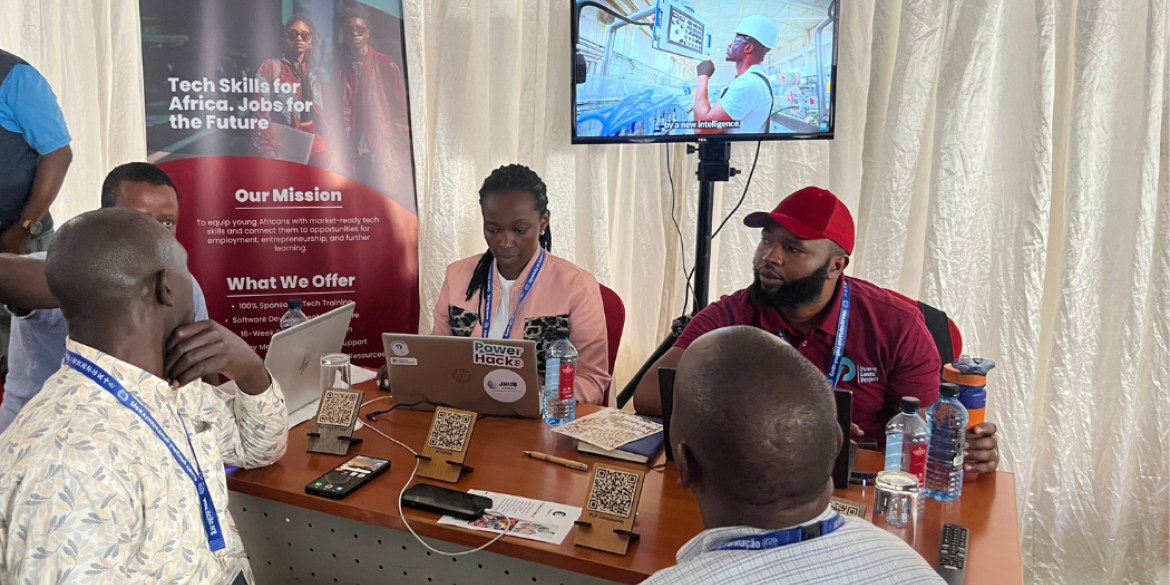
In Nairobi, the share fair went local. Kenyan start-ups such as Qhala, Lish AI Labs and the Power Learn Project let participants try tools already being built in the country, from job platforms to accessibility tools for persons with disabilities. During the forum, an app designed by ITCILO gave participants their schedules, logistics and a place to ask questions. Groups imagined Kenya in 2035 and worked backwards to 11 early prototypes, including a regional centre to train public servants in AI skills.
In Chisinau, a token fair was introduced. Each participant received 100 "AI Forum tokens", listened to short pitches at every table, and invested in the prototypes they would back in real life. Before that, an AI "critical friend" bot challenged each group's first ideas. Groups then used Lovable, a tool that builds a web prototype from a written description, to turn their plans into interactive prototypes in a single afternoon, with no coding required.
From prototype to practice
A prototype built in three days is not meant to be a finished solution. Its value lies in what teams do with it once they are back at work, as they test the idea, adapt it to what they find and keep developing it. Two teams from the 2024 forum in Turin show how differently that can play out.
ILO Chile brought a very practical problem to Turin in 2024. Staff had to move between several systems to complete even routine tasks. "From generating a purchase order to contracting someone, you usually have to open at least three or four different platforms," says Claudia Cadenasso, Senior Operations Officer at ILO Chile. At the forum, her team developed a prototype called "Tailored-Made Solutions for All". It was designed to collect data from internal systems such as IRIS and Oracle, check it, and prepare reports for donors and governments.
After the forum, the team found that connecting these systems would be difficult. Much of the data was financial and sensitive, and the approvals needed were hard to obtain. They decided to apply the same approach to fundraising instead. With ITCILO, they carried out a feasibility study and later developed a proof of concept for an AI tool that identifies funding opportunities and supports ILO staff in drafting proposals for tenders.
The forum was the first door we opened towards our prototype. I lost the fear of using AI everywhere and for everything.
Claudia Cadenasso
Senior Operations Office, ILO Chile
The team from socialprotection.org came to Turin with a clearer starting point. Mariana Balboni, who coordinates the platform, explains that they had already hired a developer to build an assistant that would answer users' questions using only the platform's content. "We arrived with an idea of what we wanted," she says. "But the forum helped us understand it better and go a bit further." During the forum, the team worked on the design of the assistant and named it SPARKS, the Social Protection Assistant for Research and Knowledge Sharing.
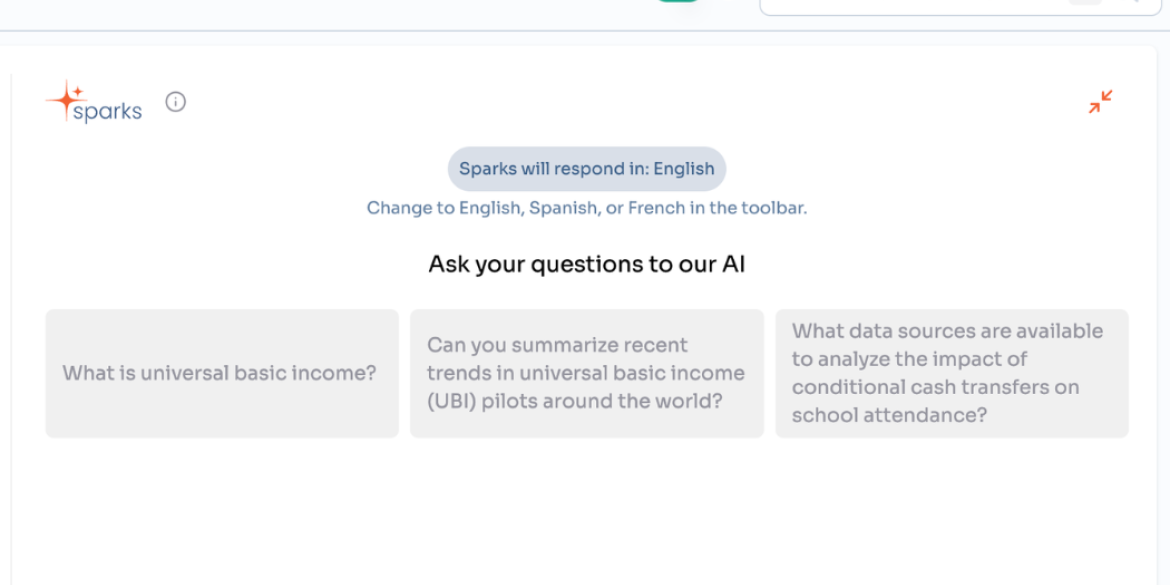
SPARKS is now available on the new socialprotection.org website. In its second phase, it is being extended to include transcripts of webinars and podcasts. Balboni notes that the work has brought challenges. Processing the platform's documents has been more expensive than planned, and the team is working to keep the assistant's answers as complete as those of general-purpose AI tools. "We are on it," she says.
To help organisations take the same approach further, ITCILO is developing a toolkit. It will bring together the methods and templates used across the three editions, so that teams can work through their own AI questions, from defining a challenge to building a first prototype. Teams using the toolkit can also reach out to ITCILO for facilitation support at any stage.
Bring your questions to our next forum
Each edition has been different from the last, with new topics, new ways of working and new tools, and the next one will be no exception. Organisations can join as participants, or partner with us to host an edition shaped around their own challenges.
Chances are, you and your organisation already have questions about AI and how to put it to work. The forum does not have to stay in Turin, Nairobi or Chisinau. It can be built around the needs of your organisation, sector or country, whether that means using AI responsibly, training staff to use it well, or deciding who is accountable when it is used.
So, what will your question be?
To host a future AI Forum, contact the Learning Innovation Programme


