
Managing Interpersonal Conflict in the Workplace

Image © Alice Lotti
Online
Managing Interpersonal Conflict in the Workplace
Prevent disputes early
16 November–4 December 2026
The course is available in English
Why does workplace conflict escalate and how can it be prevented before it does?
This online course equips HR professionals, industrial relations practitioners, and workers' and employers' representatives with practical tools for early conflict prevention, workplace cooperation, and effective grievance handling.
At a glance
Format
Online
Duration
35 hours over 3 weeks
Outcome
Certificate of Participation
Introduction to the course
While it is commonly admitted that conflict is inevitable, differences are made by the way conflict is handled. Indeed, the interactions between employees and employers within enterprises can be cooperative and harmonious, or characterized by conflict and disruption. Even where relations are generally good, the very nature of employment relations suggests that some conflict is inevitable. Such conflict can, however, be managed within the workplace itself without third-party intervention, even though assistance from third parties may be accessed from time to time on a voluntary basis. The growing costs of conflicts and their impact on production processes and employee satisfaction have driven employers and workers' organizations to establish new strategies and tools for the prevention and management of labour disputes in the workplace. This includes but is not limited to early conflict resolution, recognition of the role of workers' representatives, joint design of dispute resolution system, workplace cooperation and effective grievance handling mechanisms.
Who attends this course?
- Government, employers' and workers' representatives;
- Staff of ministries of labour involved in dispute prevention and resolution;
- Human resources managers, personnel in human resources departments dealing with industrial and employment relations;
- Labour court judges and lawyers;
- Labour administration and labour inspection officials;
- Industrial relations experts and practitioners;
- Labour lawyers;
- Consultants and graduate students;
- Practitioners in the field of industrial and employment relations from the public and private sectors;
- Staff from the ILO and other international organizations.
In the framework of the ILO's gender promotion policy, applications from women are encouraged.
Voices from the programme
Hear directly from former participants on what it takes to manage interpersonal conflict and labour disputes in the workplace.
What will I learn?
- Social dialogue, ILO conventions and recommendations on dispute prevention and resolution;
- Conflict dynamics in industrial relations;
- Effective approaches to conflict managements.
- A needs-based strategy for labour conflict prevention and resolution.
- How to build trust and stronger relations.
- An introduction to workplace cooperation as a tool to prevent the escalation of disputes
- Using effective grievance handling to deal with rights-based conflicts
What will I be able to do?
By the end of this course on managing interpersonal conflict in the workplace, you will be able to:
- Develop further knowledge on effective approaches to managing labour disputes at the workplace.
- Explore tools and strategies for the prevention of labour disputes in the workplace.
- Develop acquaintance with successful experiences in the prevention and management of labour disputes at the workplace.
- Increase the knowledge and practice of conflict management techniques that address the needs of the parties and focus on building stronger relations.
- Provide an introduction to workplace cooperation and how it can be used to prevent and manage labour conflicts.
- Introduce effective grievance handling mechanisms as a tool for prevention and management of labour disputes in the workplace.
- Promote the application of the ILO’s key principles and values on this issue.
How does the course work?
The course runs online over three weeks, requiring approximately 35 hours of engagement. Participants access a dedicated ITCILO eCampus platform, accessible via computer or portable device.
The course is structured around three main components
1. Interactive sessions
Plenary discussions, group work, and hands-on practice.
2. Final assignment
A concluding assignment leading to the award of the ITCILO Certificate of Participation.
Why join this course?

Learn differently
Innovative training methodologies and integrated use of digital learning technology.

Join a global community
Connect with a virtual community of social dialogue professionals from across the world to share knowledge and experience.

Certificate of participation
Successful participants are awarded an ITCILO Certificate of Participation.
Practical information
Language requirements
The entire training programme is conducted in English. A good command of the language is required.
Technical requirements
A stable internet connection and equipment with camera, microphone, and audio settings are required for all live sessions.
Attendance policy
A stable internet connection and equipment with camera, microphone, and audio are required for all live sessions. A minimum of 75% active participation with camera on is required to complete the course.
How to apply and enrol
Click Apply now and complete the online application form before the application deadline. If sponsored by your institution, attach a sponsorship letter covering the course fee. Applications are reviewed through a standardised selection process and successful candidates are notified individually.
Payment and cancellation terms
Payment can be made by bank transfer or credit card through an electronic payment link. The total fee must be paid in advance. To withdraw, notify the Centre in writing at least 14 days before the course start date — cancellations are subject to penalties. See the full payment and cancellation policy.
Your questions, answered
Do I need any prior experience to join this course?
No. This course is open to professionals across government, employers' and workers' organizations, HR, and industrial relations, with no formal prerequisite.
What certificate do I receive?
Successful participants who complete the final assignment and meet the attendance requirement receive an ITCILO Certificate of Participation.
Is attendance really required if the course is online?
Yes. A minimum of 75% active participation with camera on during live sessions is required to complete the course, given its interactive, discussion-based format.
Ready to build stronger, more resilient workplace relationships?
16 Nov–4 Dec 2026 · Online · English
Start learning about this topic
This course is part of the broader ITCILO Social Dialogue curriculum, spanning conciliation/mediation, negotiation, industrial relations, and more.
Deepen your understanding further with the ITCILO's special resource, the Handbook on the Psychology Components of Conflict.
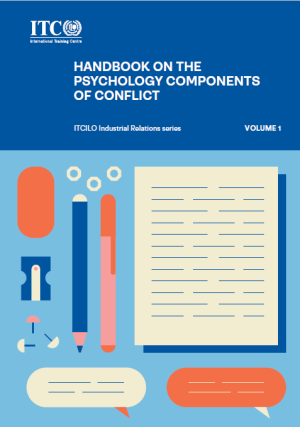
Handbook on the Psychology Components of Conflict
ITCILO Industrial Relations Series — Volume 1
A special ITCILO resource exploring the psychological dimensions of workplace conflict — from perception and emotional flooding to communication under tension and the needs-based model of reconciliation — developed with Professor Stéphanie Demoulin (UC Louvain).
This handbook is available on request — write to us at socdial@itcilo.org to receive a copy.


