From Standards to Practice: Advancing Professional Development in Social Auditing
From Standards to Practice: Advancing Professional Development in Social Auditing
How a new milestone in the ITCILO-APSCA partnership is helping social auditors turn International Labour Standards (ILS) into everyday practice
25 septembre 2026
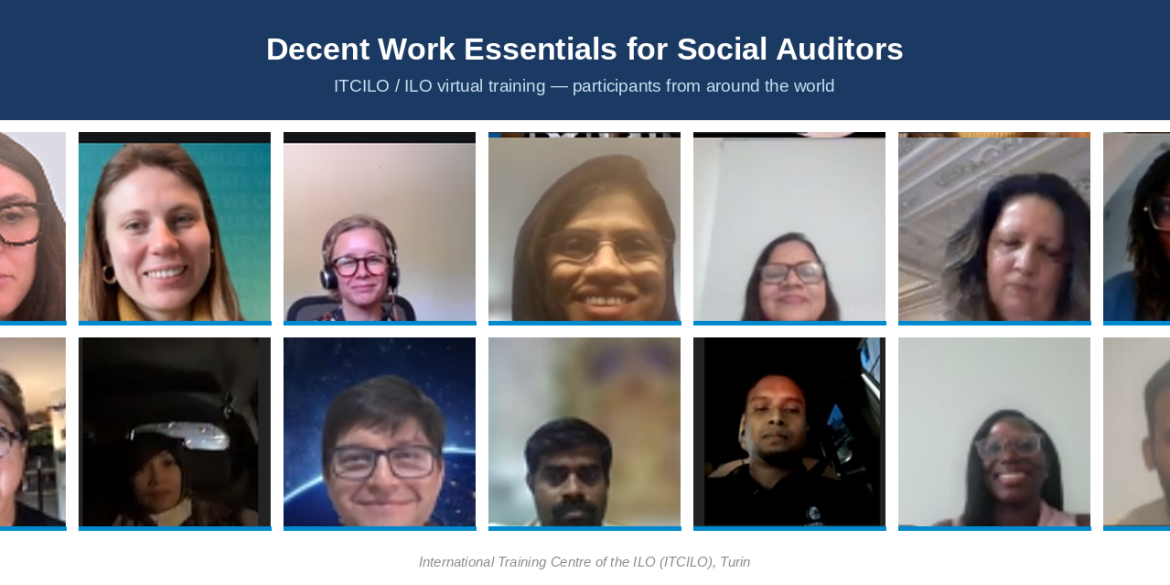
Participants from around the world join a virtual training session on Decent Work Essentials for Social Auditors.
More than 250 social auditors from around the world have successfully completed the 2026 edition of the online course “Decent Work Essentials for Social Auditors: Practice and Purpose”. The programme strengthened participants’ understanding of international labour standards and their application in social auditing. This course marks an important milestone in the collaboration between the International Training Centre of the ILO (ITCILO) and the Association of Professional Social Compliance Auditors (APSCA).
Earlier this year, ITCILO and APSCA strengthened their collaboration through a Memorandum of Understanding (MoU) focused on capacity development, knowledge exchange and professional training on labour rights, responsible business conduct (RBC) and human rights due diligence (HRDD). The new edition of Decent Work Essentials for Social Auditors was announced as one of the first concrete outcomes of that partnership.
When we launched this partnership, we emphasized the critical role social auditors play in translating ILS, RBC and HRDD into practice. Seeing more than 250 participants complete this edition, and engage with practical, innovative learning approaches confirms the value of this collaboration and give us a strong foundation to build on.
Linda Deelen
Manager, Sustainable Enterprises and Economies, ITCILO
A joint effort between the International Labour Organization (ILO), the International Training Centre of the ILO (ITCILO), the Initiative for Compliance and Sustainability (ICS), the International Trade Centre (ITC) and the Association of Professional Social Compliance Auditors (APSCA), the course was designed to respond to a clear and growing need. As expectations around responsible business conduct and human rights due diligence continue to evolve, social auditors increasingly need practical ways to apply ILS in complex workplace environments.
Learning through exchange
The learning programme combined self-guided modules with live webinars, moderated discussions and opportunities for peer exchange. Participants had the opportunity to learn and discuss the ILO Decent Work Agenda, taking a deep dive into the International Labour Standards (ILS) related to the evolving role of social auditing.
The live webinars became one of the highlights of the learning journey. They created a space to move beyond theory and openly discuss the challenges auditors face in practice, share good practices and bring ILO expertise into conversation with auditors' professional experience. Participants were able to share approaches across countries and sectors, ask questions and reflect collectively on how international labour standards can be applied in complex audit situations.
Professional social auditing depends on continuous learning, professional judgement and a strong understanding of evolving expectations around labour rights and responsible business conduct. Through this partnership with ITCILO, we have been able to provide auditors with practical learning opportunities that support both individual professional development and the continued strengthening of the profession as a whole.
Kara Chan
APSCA Director of Exam and CPD
Putting learning into practice
The programme created opportunities for social auditors to exchange practical experiences, discuss challenges and learn from peers working in different contexts. The practical dimension became particularly visible in the final assignment. Participants worked through an audit case study that required them to observe workplace situations, identify potential labour issues, triangulate information and conduct an interview through a live AI-powered avatar before developing their audit findings. The simulation was one of the most positively received elements of the course. Participant feedback highlighted the value of realistic scenarios and interview practice, and several participants asked for even more simulations, case studies and opportunities to practice evidence triangulation, worker interviews and professional judgement in future editions.
The evaluation results confirmed the relevance of the approach. Nearly 98% of respondents reported being satisfied with the overall quality of the training, 98% said they would recommend it to others, and more than 95% felt more confident applying their newly acquired knowledge in their work.
The course was an invaluable resource during my preparation for the APSCA Exam 2. I particularly appreciated how it combined a strong foundation in social compliance and labour issues with practical guidance on identifying and assessing workplace risks. The section on soft skills was especially valuable, providing practical techniques for building rapport, handling sensitive conversations, and conducting effective worker interviews.
Liza Rodriguez
Social Compliance Auditor at ARCHE Advisors
Beyond the figures, participants repeatedly emphasized the value of connecting ILS with everyday auditing practice. Their feedback also points towards the future, with strong interest in more advanced worker-interview techniques, evidence triangulation, root-cause analysis, identification of hidden labour risks and realistic audit simulations.
This interest reflects the practice-oriented approach of the programme, which uses real-life scenarios, challenging cases and AI-supported simulations to strengthen auditors' soft skills, professional judgement and ability to navigate complex situations while keeping workers' rights and Responsible Business Conduct (RBC) at the center of their work.
Strengthening the profession
The completion of the 2026 edition is therefore not the end of the learning journey. It provides a foundation for a growing community of social auditors who can continue exchanging experiences, discussing emerging challenges and strengthening the connection between international labour standards and auditing practice.
Building on the success of this edition, ITCILO and APSCA will continue exploring opportunities to support professional development in social auditing. The ambition is to keep growing this community and create opportunities for auditors to learn not only from international standards and experts, but also from each other.
From standards to practice, the course has shown the value of combining a strong normative foundation with practical application, professional exchange and innovation. The next step is to build on that momentum and continue strengthening the global community of social auditors working to advance decent work across global supply chains.


