
Certification Course on Conciliation/Mediation of Labour Disputes - Module 2 Online

Image © Alice Lotti
Online
Certification Course on Conciliation/Mediation of Labour Disputes - Module 2 Online
GET YOUR COMPETENCIES FORMALLY ASSESSED
21 September–16 October 2026
The course is available in English
Next editions
How can effective conciliation/mediation prevent workplace conflict from escalating into major labour disputes?
Find out in Module 2 of the ITCILO Conciliation/Mediation Certification Path—an intensive, interactive programme where labour dispute resolution practitioners and labour relations professionals strengthen their interpersonal and professional competencies, demonstrate their skills through a rigorous competency-based assessment process, and earn an internationally recognized ITCILO Certificate of Achievement.
At a glance
Format
Online
Duration
30 hours over 4 weeks
Prerequisite
Completion of Module 1
Outcome
Certificate of Achievement
Introduction to the course
Conciliation/mediation skills are not innate - they require study, self-reflection, and sustained practice. Designed by the ITCILO and the ILO as the practical continuation and formal assessment of Module 1, this Certification Course evaluates and strengthens participants' professional competencies as conciliators/mediators. It is the second step in the ITCILO Conciliation/Mediation Learning Path and requires prior successful completion of the Online Course on Conciliation/Mediation of Labour Disputes - Module 1. Please note that this course does not grant professional accreditation or imply any right to employment with a dispute resolution body.
Who attends this course?
This course is designed for practitioners who have successfully completed Module 1 and are ready to have their conciliation and mediation competencies formally assessed in an online setting. Participants typically include: Staff of labour dispute agencies and ministries of labour Employers' and workers' representatives with experience in dispute resolution Industrial relations experts and practitioners Labour lawyers and practising conciliators/mediators
Admission requirements
Completion of Module 1 with an ITCILO Certificate of Participation is mandatory to join Module 2 Online.
Module 2 is the formal assessment of the skills built in Module 1 — and is available in two formats: online (this page) or residential (Full Certification Course).
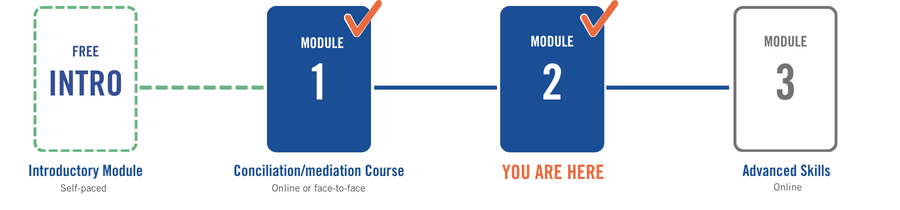
Haven't completed Module 1?
Consult the ITCILO Conciliation/Mediation Learning Path to find the next avialable edition of Module 1 online or apply for the Full Certification that combines Module 1 and Module 2.
Voices from the programme
Hear directly from former participants on what it takes to master conciliation/mediation of labour disputes.
What will I learn?
1. Conflict dynamics and conflict management
Advanced application of conflict analysis frameworks. Participants learn to identify escalation patterns and selecting appropriate intervention strategies in live dispute scenarios, grounded in ILO guidance on labour dispute prevention and resolution.
2. Principles and ethics of conciliation/mediation
Deepening understanding and adoption of the core principles of conciliation/mediaton aligned with the relevant ILO standards, including Conventions No. 92 and Convention No.154. These principles are applied under assessment conditions in coached and evaluated role-plays.
3. Interpersonal skills for conciliation/mediation
Advanced application of active listening, reframing, empathy, effective communication, questioning and trust-building techniques in complex and high-pressure labour dispute situations.
4. Process, problem, and people management skills
Application of the ITCILO conciliation/mediation process across all stages, with particular attention to identifying interests, managing power imbalances and impasses, and addressing emotionally complex situations in a structured and impartial manner.
5. Coached practice and competency-based assessment
Participants take part in four live role-play exercises: two coached sessions and two assessed sessions. Acting as conciliators/mediators, they apply the full conciliation/mediation process in realistic labour dispute scenarios and receive structured feedback against the ITCILO Matrix of Competences. Each session lasts four hours and is conducted in small groups to allow for intensive practice, observation and assessment.
Meet your tutors

Ebrahim Patelia
Director, Mediate Works (PTY) Ltd
Ebrahim is a director at Mediate Works (PTY) Ltd and a consultant at Cliffe Dekker Hofmeyr. He has over 25 years’ experience in dispute resolution, legal advisory services, training and process design. His experience uniquely integrates the practice of law, dispute resolution and academic work.

Malcolm Currie
Independent Consultant, Mediator and Assessor
Malcolm founded Strathesk Resolutions after 11 years as a union negotiator. Engaging with employers in private, public and third sectors, he developed expertise in negotiation, partnership, resolving disputes and tackling individual cases, skills grown from 15 years advising and influencing countryside managers over land-management and joint projects.

Eleni Charalambidou
Independent mediator and trainer
Eleni is a full-time mediator and trainer from Cyprus and Greece. She has extensive experience designing and delivering professional training courses on conflict resolution and negotiation at the international level since 2015.
What will I be able to do?
By the end of this certification course on conciliation/mediation of labour disputes, you will be able to:
- Demonstrate professional-level competencies in conciliation/mediation assessed against the ITCILO Matrix of Competences
- Conduct full conciliation/mediation sessions across all stages of the ITCILO approach on this subject matter
- Apply advanced soft skills under assessed conditions
- Manage complex dispute situations including power imbalances, impasse, and high-conflict dynamics
- Reflect critically on your own practice through a structured Personal Development Plan
- Earn internationally recognised certification as a conciliator/mediator
How does the course work?
Building on the foundational knowledge and practical exercises acquired in Module 1, this Certification course - Module 2, focuses on the formal assessment of your conciliation/mediation skills.
It involves approximately 30 hours of engagement and is delivered on the ITCILO e-Campus learning platform.
The assessment is structured around three main components
1. Role-plays
Two coached and two assessed live role-plays, acting as conciliator/mediator through every stage of the process.
2. Written test
Multiple-choice and short-answer questions testing your grasp of key principles, ethics, and practice.
3. final essay
A structured written reflection on your strengths, growth areas, and next steps as a practitioner.
Why join this course?

Formal assessment
Your conciliation/mediation skills are formally assessed through role-plays, a written test, and a final esay, leading to an ITCILO Certificate of Achievement.

Expert coaching and feedback
Practice in coached and assessed role-plays with internationally recognised conciliators and mediators, and receive structured, individualised feedback.

Gateway for Module 3
Module 2 certification is the required prerequisite for Module 3 — Advanced Skills for Conciliators/Mediators, your next step to expertise.
Practical information
Language requirements
The entire training programme is conducted in English. A good command of the language is required. This course is also available in Spanish.
Technical requirements
Stable internet connection; computer or laptop with working camera, microphone, and headset; a quiet environment for all live sessions.
Attendance policy
Given the nature of the small-group role-play format, absence from a session affects the work of the entire group. For this reason, 100% attendance at all live sessions is mandatory.
How to apply and enrol
Complete the online application form via Apply Now before the deadline. If sponsored, attach a sponsorship letter stating the full fee. Successful applicants are notified individually after review.
Payment and cancellation terms
The total fee must be paid in advance. To withdraw, notify the Centre in writing at least 14 days before the course start date. See the full payment and cancellation policy.
Your questions answered
Can I join Module 2 Online without having completed Module 1?
No. Completion of the Online Course on Conciliation/Mediation of Labour Disputes — Module 1 with a Certificate of Participation is a mandatory admission requirement. The assessment in Module 2 builds directly on the skills and frameworks introduced in Module 1. If you have not yet completed Module 1, please consult the ITCILO Conciliation/Mediation Learning Path.
Is there a residential alternative to this online format?
Yes. The Full Certification Course — Module 1 and Module 2 Residential is a five-day face-to-face programme in Turin that combines both modules. It is open to participants who have only completed the free introductory self-paced course and does not require prior completion of Module 1 Online.
What happens if I do not pass the assessment?
Participants who do not meet the required competency threshold will not receive the Certificate of Achievement. ITCILO assessors provide detailed feedback to support your continued development. You may apply to retake the course in a future edition.
Ready to earn your conciliation/mediation certification?
21 Sep–16 Oct 2026 · Online · English · Limited seats
Continue your learning journey
Module 2 certification is the gateway to the next stage of your development as a conciliator/mediator and part of the broader ITCILO Social Dialogue curriculum.


Explore all


