
Advanced Skills for Mediators: Effective Strategies for Conflict Management and Resolution - Module 3 Online

Image © Alice Lotti
Online
Advanced Skills for Mediators: Effective Strategies for Conflict Management and Resolution - Module 3 Online
Master complex conciliation/mediation
26 octobre–13 novembre 2026
Le cours est disponible en English
Prochaines éditions
What does it take to mediate when both sides have already dug in?
This is where ITCILO-certified conciliators/mediators go to sharpen the strategic and psychological edge that separates competent practice from real mastery — the final stage of the ITCILO Conciliation/Mediation Learning Path.
At a glance
Format
Online
Duration
60 hours over 3 weeks
Prerequisite
Module 2 certification
Outcome
Certificate of Achievement
Présentation du cours
As labour disputes become increasingly complex, conciliators and mediators are required to move beyond foundational techniques and strengthen their strategic, emotional and adaptive capacities. Effective conciliation/mediation today demands the ability to manage power dynamics, reframe entrenched positions, facilitate interest-based dialogue and navigate high-pressure environments with confidence and professionalism. To further enhance these competencies, the ITCILO has developed this advanced, practice-oriented course specifically designed for certified conciliation/mediation practitioners. Through immersive case studies, structured simulations and expert-guided reflection, participants consolidate and further develop their capacity to manage complex disputes and apply conflict transformation tools effectively - grounded in ILO standards on labour dispute prevention and resolution.
Groupes cibles
This course is exclusively designed for ITCILO-certified conciliators and mediators who have successfully completed and passed both Module 1 and Module 2 of the ITCILO Conciliation/Mediation Learning Path.
Admission requirements
The ITCILO Conciliation/Mediation Learning Path is a structured progression of courses designed to take practitioners from foundational knowledge to internationally recognised certification and advanced practice. Module 3 is the final stage — deepening and extending the competencies formally assessed in Module 2.
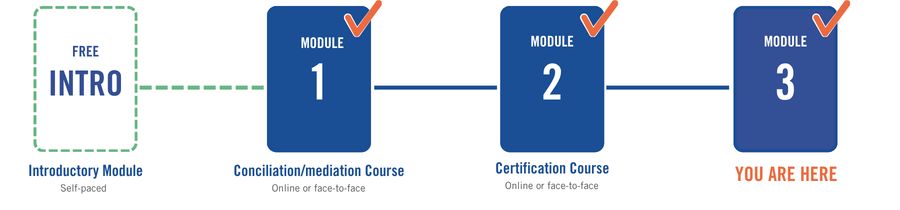
Haven't completed Module 2?
Completion of the Certification Course on Conciliation/Mediation of Labour Disputes — Module 2 with a Certificate of Achievement is required for enrolment. Consult the full ITCILO Conciliation/Mediation Learning Path to find the nearest edition.
What will I learn?
1. Advanced strategies for complex conciliation/mediation processes
Strengthen your capacity to plan, structure and adapt conciliation/mediation processes in complex labour dispute situations, drawing on ILO guidance on labour dispute prevention and resolution.
2. Managing complex, multi-party and high-conflict disputes
Develop practical strategies for disputes involving multiple parties, fragmented interests, power imbalances, strong emotions and challenging behaviours, including in collective bargaining and labour relations contexts.
3. Conflict dynamics, power and professional judgement
Analyse how power relations, perceptions, emotions, cognitive biases and behavioural dynamics influence disputes, and strengthen your professional judgement in selecting the most appropriate intervention strategy.
4. Advanced communication and interest-based dialogue
Refine active listening, reframing, strategic questioning and other communication techniques to build trust, uncover underlying interests, overcome entrenched positions and facilitate constructive dialogue.
5. Overcoming impasses and supporting sustainable agreements
Apply advanced techniques to address deadlock, generate options for resolution and assist parties in developing realistic, mutually acceptable and jointly owned agreements that support sustainable labour relations.
6. Advanced practice through complex simulations
Apply and refine advanced conciliation/mediation strategies through realistic and challenging labour dispute simulations, combined with structured feedback, peer exchange and facilitated reflection on professional practice.
What will I be able to do?
By the end of this advanced online course on conciliation/mediation of labour disputes, you will be able to:
- Design and adapt conciliation/mediation strategies for complex, multi-party and high-conflict labour disputes.
- Analyse and manage complex dispute dynamics, including power imbalances, behavioural patterns, strong emotions and challenging interactions.
- Apply advanced communication techniques — including active listening, reframing and strategic questioning — to build trust, clarify interests and support constructive dialogue.
- Exercise sound professional judgement in selecting appropriate interventions, managing the process and responding to changing dispute dynamics.
- Address impasses and facilitate interest-based problem solving, helping parties generate mutually acceptable options and work towards sustainable agreements.
- Strengthen your professional practice through complex simulations, structured feedback, peer learning and facilitated reflection.
Why join this course?

Strategic mastery
Go beyond the foundations and certification: this course develops the advanced strategic, psychological and adaptive capacities needed for complex, high-stakes dispute resolution.

Personalised feedback
Receive expert guidance and individualised coaching from experienced practitioners with international field experience.

A network of certified practitioners
Engage with conciliators and mediators from different countries and institutional contexts, sharing advanced practices in alternative dispute resolution.
How does the course work?
This advanced online course runs over three weeks, requiring approximately 60 hours of engagement — roughly double the commitment of Modules 1 and 2, reflecting the depth and intensity of advanced practice.
Participants access the course through the ITCILO eCampus platform, accessible via computer or portable devices. Learning is interactive, practice-oriented and tutor-facilitated throughout.
The course is structured around three main components
1. Live sessions
Held on Tuesdays, Wednesdays and Thursdays (Italy time). Attendance is mandatory and recorded.
2. Simulations
Structured practical exercises and simulations throughout the course, building strategic and adaptive capacity in realistic dispute scenarios.
3. Practical Assignment
A structured written assignment submitted at the end of the course.
Practical information
Language requirements
The entire training programme is conducted in English. A good command of the language is required.
Attendance policy
Given the nature of the small-group role-play format, 100% attendance is mandatory.
How to apply and enrol
Click Apply Now and complete the online application form before the application deadline (16 October 2026).
- If sponsored by your institution, attach a sponsorship letter covering the course fee (€1,135).
- If self-sponsored, upfront payment of the full course fee is required to formalize your enrolment.
Payment can be made by credit card or bank transfer.
Applications are reviewed through a standardised selection process and successful candidates are notified individually.
Questions? Contact socdial@itcilo.org. Course code: A9718880.
Payment and cancellation terms
The total fee must be paid in advance. To withdraw, notify the Centre in writing at least 14 days before the course start date. See the full payment and cancellation policy.
Technical requirements
Stable internet connection; computer or laptop with working camera, microphone, and headset; a quiet environment for all live sessions.
Your questions, answered
Can I join Module 3 without having completed Module 2?
No. Completion of the Certification Course on Conciliation/Mediation of Labour Disputes — Module 2, with an ITCILO Certificate of Achievement, is a mandatory prerequisite. Module 3 is designed for practitioners who have already been formally assessed and certified, and builds directly on the competencies verified in Module 2.
How is Module 3 different from Modules 1 and 2?
Module 1 builds foundational knowledge and practical skills. Module 2 formally assesses those skills against the ITCILO Matrix of Competences. Module 3 goes beyond certification: it deepens strategic, psychological and adaptive capacities for managing complex and high-stakes disputes. It requires approximately 60 hours of engagement — double that of Module 2 — reflecting the depth and intensity of advanced professional practice.
What certificate do I receive?
Successful participants receive an ITCILO Certificate of Achievement recognising advanced professional competence in conciliation/mediation. Learn more about ITCILO digital credentials.
Is 100% attendance really required?
Yes. Given the small-group, simulation-based format of this course, missing a session disrupts the entire group's practice — so 100% attendance at all live sessions is mandatory. ITCILO is not responsible for unsuccessful completion due to connectivity or technical issues on the participant's side.
Ready to take your conciliation/mediation practice to the next level?
26 Oct–13 Nov 2026 · Online · English
Keep building your expertise
Having completed the ITCILO Conciliation/Mediation Learning Path, explore the ILO framework underpinning professional dispute resolution — through the ILO's guidance on labour dispute prevention and resolution and ILO standards on collective bargaining and labour relations — or continue growing within the broader ITCILO Social Dialogue curriculum.
Professional conciliation in collective labour disputes
A practical guide
The Guide was prepared as a revision of the ILO Practical Guide on Conciliation in Industrial Disputes, which was first developed in 1973 and updated in 1988. Kevin Foley and Maedhbh Cronin authored this revision so as to update the contents in order to take account of environmental, economic, practice and other changes which have taken place in the field of conciliation/mediation in more recent decades. The Guide also contains case studies from a number of European dispute resolution agencies so as to illustrate how conciliation/mediation actually works to assist collective bargaining and settle collective labour disputes. It is intended for use as a training tool in the ITC Certification Course on Conciliation/Mediation and in the sub-region, and will subsequently be published as a global tool with case studies from other regions.


