
Leverage behavioural science to enhance the impact of learning and communication

© Unsplash/Luke Jones
Leverage behavioural science to enhance the impact of learning and communication
This tailor-made course is available upon request and may be customized for local, national, and international contexts.
El curso está disponible en English
The UN 2.0 Quintet of Change has nominated behavioural science as one of the five key skill sets necessary to face the future. With organizations, institutions, and companies that strengthen their behavioural science capabilities, they can better understand human behaviours, further increasing the impact of their strategies.
Key features
TAILORED TO YOUR CONTEXT
Co-designed with your organization to address the specific challenges and opportunities you face.
HANDS-ON INTEGRATION
Participants work directly with BeSci tools and approaches to put theories directly into practice.
PROJECT-BASED LEARNING
Group work focuses on real, problem-based scenarios drawn from the institutional context.
Behavioural insights for decision-making
A skill set in behavioural science gives insight into human nature and how people behave, decide, and interact with policies and motivations. This interdisciplinary domain fuses psychology, economics, and sociology among other fields.
Naturally, humans catch onto behavioural quirks, sometimes without even realizing it. Nevertheless, many policies, processes, and products are based on the traditional economic model that assumes and generalizes human behaviours. If the aim is to create policies, processes, and products that actually support human development and drive long-term commitment, then behavioural science helps us better understand human beings.
Behavioural insights also reveal how much our choices are shaped by cognitive biases, emotions, and context rather than by information alone. Recognizing these patterns is the first step towards lasting behaviour change, helping learning and communication move beyond raising awareness to influencing what people actually do.
How will I learn?
As stated in its name, it is a science that requires a coherent and clear methodology. To bring behavioural science projects from concept to reality there are five key recommended steps to make the project a success: Define the outcome and target behaviour; Understand the context and identify the behavioural factors at play; Design a behaviourally-informed intervention; Test and evaluate; and Learn, adapt, and communicate findings. The steps are elaborated on in the graphic below:
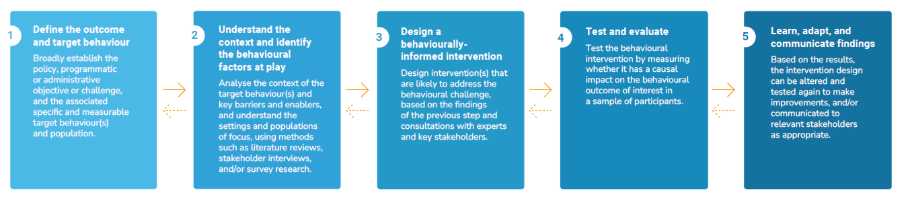
Source: UN Practitioner's Guide to Getting Started with Behavioural Science
What will I learn?
Tapping into behavioural science in learning and communication strategies can make a profound impact on their effectiveness. The ITCILO will work directly with your context to identify which approaches to follow to bring viable solutions. Here are some potential opportunities for incorporating behavioural science in learning and communication:
- Nudging: Put simply, nudging is “a subtle shift in the way options are presented.” This (gently) presents a preferred or recommended choice to someone, while still giving them ownership of the decision. A platform about gender-aware policy development used nudging to guide people’s choice architecture towards more inclusive policies.
- KISS Design: In today’s digital age, attention spans are reducing continuously urging online communications to follow the Keep It Simple and Structured (KISS) principle. By redesigning an email template, a university was able to boost application rates by 3 percentage points, from 9% to 12% of students.
- Neurotechnology: Wearable brain-sensing devices are opening new ways to understand attention, focus, and fatigue as they happen, replacing self-guessing with direct signals from the brain. Training institutions are starting to experiment with how wearable technology can provide insights into how to enhance learning and engagement.
- Dynamic Listening: Understanding the context is fundamental in behavioural science, so involving beneficiaries through focus group discussions facilitates multi-source data collection. WHO in Malaysia utilized behavioural insights in their communication actions post-COVID-19 to safely reopen the country and encourage citizens to continue following protective behaviours.
- Deep Learning: Experiential learning demonstrates that humans retain more of what they do than what they read or see, which unlocks opportunities to shift behaviours and instil values. Virtual Reality (VR) can eliminate gender bias or even have a significant impact on combating climate change by demonstrating a dystopian reality without pollinators.
Artificial intelligence is opening new possibilities for applying behavioural science to learning and communication. From analyzing how audiences engage to testing different versions of a message, AI can speed up each step of the behavioural process. A growing range of AI-powered tools can even act as thinking partners when designing interventions. Yet AI can also reproduce the very biases behavioural science seeks to address, so combining these tools with human judgement, real-world testing, and a clear ethical compass is key to using them responsibly.
"It’s about building policy around real human beings and how real people make decisions as opposed to what an economic textbook teaches you."
- David Halpern, Psychologist and author of " Inside the Nudge Unit"
Who attends this course?
- Trainers, facilitators, and instructional designers looking to build behaviourally informed learning experiences
- Communications and outreach officers who want messages, campaigns, and channels to actually change what audiences do
- Policy and programme officers designing interventions, services, or processes that depend on human uptake
Who are the trainers?
The training for this course will be conducted by a team of highly experienced and certified international facilitators from the ITCILO Learning Innovation Programme. The course may also tap into the international expertise of professors, researchers, and practitioners.


