New Technologies, Human Choices: Inside ITCILO Innovation Day 2026
New Technologies, Human Choices: Inside ITCILO Innovation Day 2026
From robots and quantum computing to neurotechnology and virtual worlds, ITCILO Innovation Day explored what happens when artificial intelligence meets the next generation of technology
28 Octubre 2026
©Michael Aboya
Artificial intelligence is already changing how we learn, work and make decisions. But AI rarely operates alone. Instead, it interacts with a myriad of existing and emerging technologies, begging the question of what happens as the technology becomes even more powerful. Who is shaping the technology and who gets to decide what we do with it? Who is excluded? Who lacks access? And how do we ensure that humans remain at the centre of the use, development and deployment of this technology? These questions shaped ITCILO Innovation Day, held on the 30th of September 2026.
Bringing together ITCILO staff and participants of the AI+ Nonference, the event explored what emerging technologies could mean for learning, social justice and the future of work.
Opening the event, Tom Wambeke, Chief of Learning Innovation, introduced three forces shaping this rapidly changing landscape: convergence, exponentiality and meta-eruption. As technologies increasingly come together, they demand more interdisciplinary ways of thinking and working. At the same time, the exponential pace of technological change challenges organisations accustomed to incremental progress. And all of this is unfolding against a backdrop of geopolitical, climate and economic upheavals, creating unprecedented complexity. For Wambeke, these overlapping transformations make one thing clear: waiting is not an option. The cost of inaction is simply too high.
But what does responding to these changes look like in practice? And how can organisations move beyond observing technological developments to actively experimenting with them, questioning their implications and shaping their use?
At the ITCILO, these questions are already informing work across a range of emerging technologies. Innovation Day 2026 offered an opportunity to bring some of that work into the spotlight, beginning with four short presentations by colleagues exploring the possibilities and challenges of virtual and extended reality, robotics, quantum technologies and neurotechnology.
Innovation at the ITCILO
Virtual and Extended Reality
Nicole Pallares Ferrer, the ITCILO’s Extended Reality Specialist, demonstrated how the convergence of AI and extended reality could dramatically reduce the technical barriers involved in creating virtual environments and the characters that inhabit them. For learning, this creates an intriguing possibility: instead of simply discussing possible futures, learners could step inside them. Virtual environments can allow learners to explore consequences, hear competing perspectives and experiment with decisions while there is still time to make different choices in the real world.

©Christoph Brehme
“With these new AI-powered virtual worlds, we can move discussions about the future of work towards a fully embodied experience. We can bring participants inside of any possible world, and then we can make them interact with the people living in it.” - Nicole Pallares Ferrer, ER and VR Specialist
Robotics
Maria Vittoria Franceschelli, ITCILO Programme Officer, challenged everyone to rethink their relationships with robots. From its creation, robots were imagined as machines that would work for humans, with the origin of the word robot coming from the Czech word robota, associated with forced or compulsory labour.
Instead of this, Franceschelli proposed an alternative reality: humans and machines working together.

©Michael Aboya
"Sometimes we rely on technology; sometimes technology relies on us. Human–robot collaboration starts with understanding what people need and what robots can actually do. A human-centred approach means designing and using technology to support different needs, make participation easier and help people work better together." - Maria Vittoria Franceschelli, ITCILO Programme Officer
Quantum technologies
Some emerging technologies may reshape not only how people work, but the skills they need to participate in the labour market at all. Quantum computing is one example. The emerging quantum economy would require a much wider ecosystem of professionals, with many of today's professions becoming quantum-adjacent.
Workers may not need to become quantum physicists. They may instead need to expand existing skill sets so they can understand, work alongside or make decisions about quantum technologies. This creates a familiar challenge for the world of work. If technological transitions are inevitable, equitable access to the skills required to navigate them cannot be an afterthought.The ITCILO is already taking steps to address this challenge through its masterclass on quantum readiness for the world of work.

©Michael Aboya
"At the ITCILO, we will continue to ensure that this quantum-oriented future remains within everyone’s reach, especially for those that are most at risk of being socially, economically, and legally discriminated in the labour force." - Carlotta Clivio, Quantum Lead at the Development Investment Programme
Neurotechnologies
Neurotechnology is already moving beyond medical environments into areas such as meditation, sleep, learning, and work. Combined with AI, its potential becomes significant.
Consider a headset capable of detecting signals associated with focus, stress and cognitive reactions. Or a learning experience that recognises when someone's concentration is falling and suggests a break. But turn the same technology around. What if an employer could monitor when a warehouse worker loses focus? What if a company had access to employees' stress data? What if an algorithm made decisions based on information generated by human brains?
With neurotechnology, it is important to think about power. Who owns the data and who are these devices listening for?

©Christoph Brehme
“Now, as with most technologies, there is also an uncomfortable side, because the same technology that gives access can take it away. Our role at the ITCILO can mean becoming a place where our constituents come to learn, try, and collectively shape these technologies through social dialogue.” - Fausto Saltetti, Neurotechnology Lead at the Learning Innovation Programme
New technology, familiar questions
Beyond the possibilities of virtual worlds, robotics, quantum computing and neurotechnology, other emerging technologies are already raising important questions about how we learn, work and navigate an increasingly digital world: How can we make skills and qualifications more portable? How can data help governments make better employment decisions? And how can we protect businesses and workers from growing digital threats?
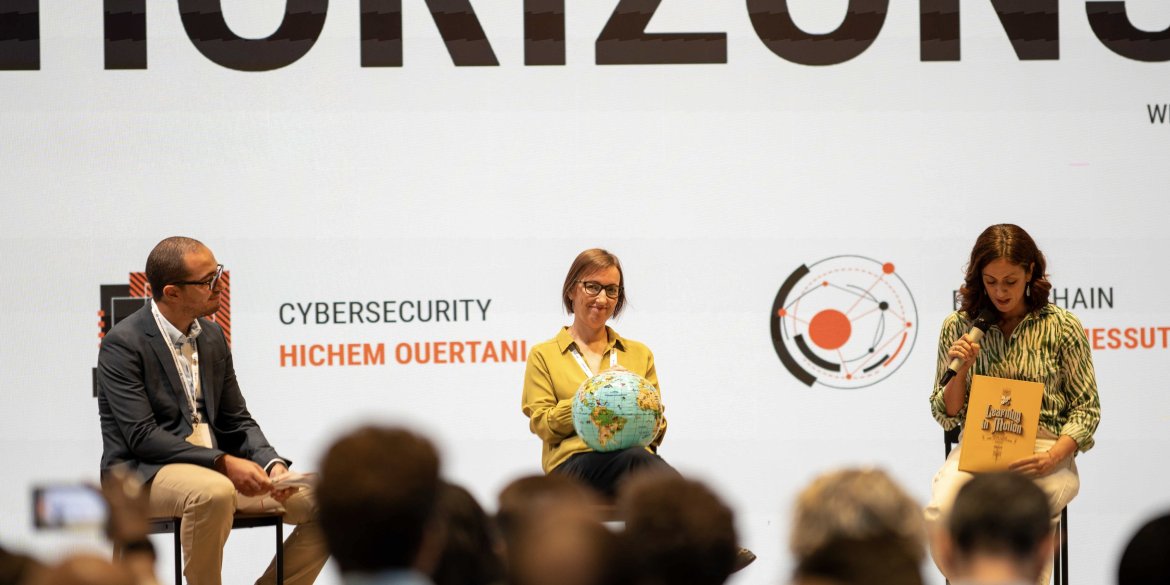
Guided by Stefano Merante, Head of the Catalyst Initiative, three ITCILO colleagues brought these questions into focus through a discussion on blockchain, geospatial data and cybersecurity.
©MIchael Aboya
Blockchain: Making skills visible and portable
Blockchain and AI will transform the way learning achievements are recognised. Building on the ITCILO’s shift towards verifiable digital credentials in 2020, Alessia Messuti, Emerging Technology Lead, highlighted how AI could help learners identify skills gaps and personalise their learning journeys, while blockchain could securely record and verify their achievements. The ambition is to make learning more portable across jobs, sectors and countries.
Geospatial data: Making better employment decisions
Rute Mendes, Programme Officer for Youth Employment, examined how geospatial data, combined with AI, could improve labour market analysis and employment policymaking. By mapping where workers, businesses, jobs and infrastructure are located, governments could identify inequalities and opportunities at increasingly local levels. A key opportunity was using satellite and other geospatial data to fill information gaps, particularly where traditional statistics are outdated or unavailable, enabling faster, more targeted and evidence-based policy responses.
Cybersecurity: Protecting businesses means protecting jobs
Cybersecurity was positioned as an emerging decent work concern, particularly for small and medium-sized enterprises in developing economies. As AI makes cyber threats, including phishing and data misuse, increasingly sophisticated, businesses face growing risks to their operations, workers and livelihoods. What emerged with Hichem Ouertani from the Sustainable Enterprises and Economies programme, was the need to prioritise practical cybersecurity governance, responsible AI adoption and stronger organisational resilience, rather than focusing exclusively on complex technical solutions.
Four principles for a fair digital transition
For the ITCILO, technological experimentation is not an end in itself. The goal is to understand how innovation can contribute to a human-centred and fair digital transition.
Achieving this goal requires a shift in perspective: moving beyond simply adopting new technologies or exploring what machines can do, towards shaping how they can strengthen human capabilities, improve working lives and ensure that the benefits of innovation are shared by all.
The ILO is not in the business of substituting human labour with machines. The ILO is in the business of exploring pathways with human-machine collaboration for enhancing the productivity of people and supporting them to make that transition.
Andreas Klemmer
Director of Training
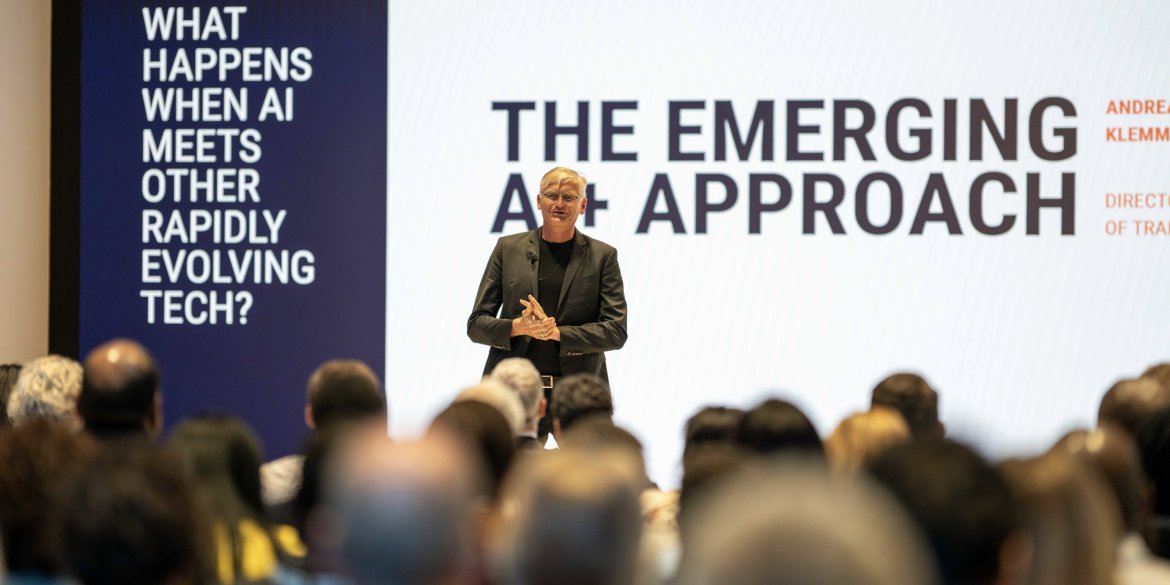
Four principles emerged from Andreas Klemmer’s keynote. At the ITCILO, our human-centred and fair digital transition will:
- Be rules-based, grounded in international labour standards and accompanied by new forms of governance where existing rules are insufficient.
- Have a positive employment impact, using technology to enhance human capabilities rather than treating the replacement of people as the default measure of progress.
- Contribute to social protection, exploring how technology can improve safety, resilience and access to safeguards.
- Be inclusive, bringing governments, workers and employers into decisions about technological transitions rather than imposing those transitions upon them.
Innovation at the ITCILO is not about predicting exactly what the future will look like. Nor is it about embracing every new technology simply because it exists. It is about creating spaces where people can encounter emerging technologies early enough to question them, experiment with them and imagine alternatives. We believe that if emerging technologies are going to transform the world of work, the people whose lives they will transform should have a hand in creating that future.